
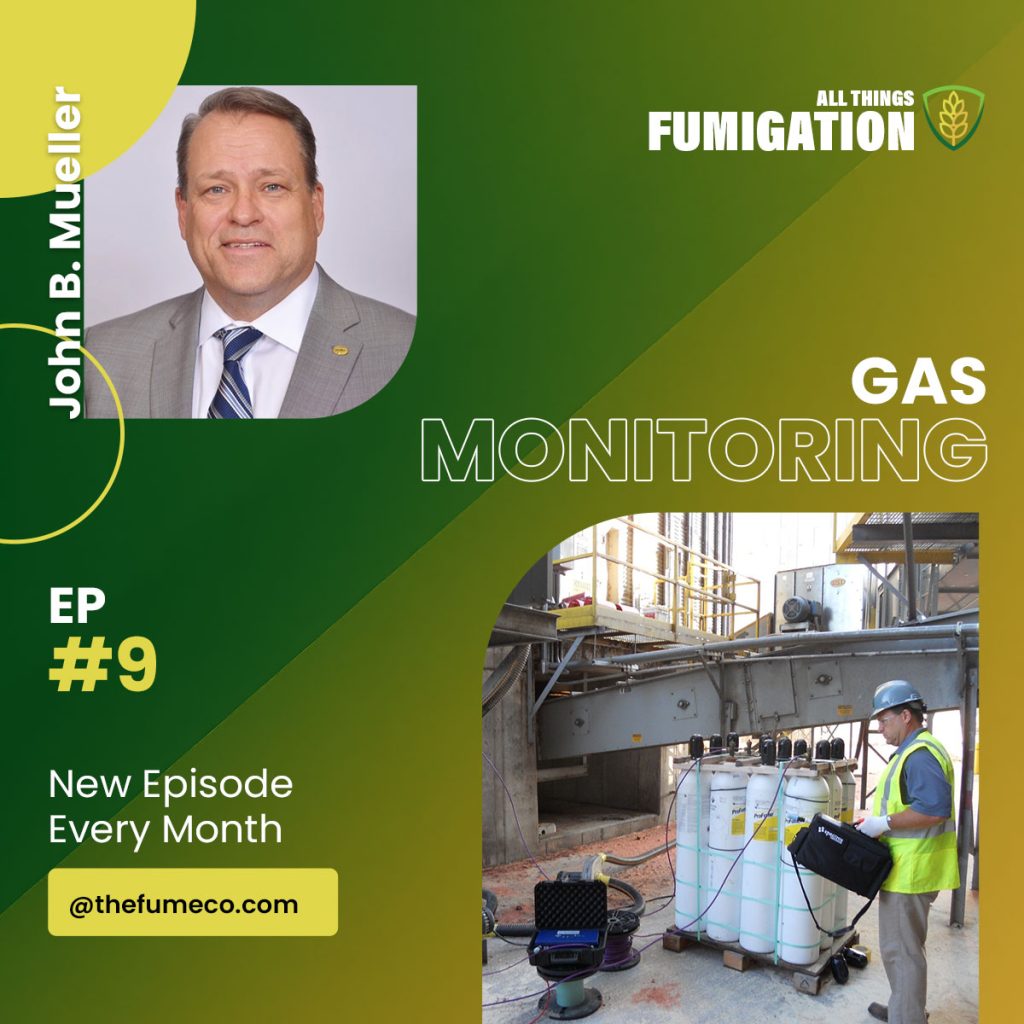
Gas Monitoring | Episode 9
Avoiding Costly Mistakes Why Continuous Gas Monitoring Matters
In episode 9 of All Things Fumigation, John focuses on the essential practice of fumigant gas monitoring and illustrates its importance with relatable analogies, such as never driving a car without a gas gauge. The episode addresses frequent excuses and faulty practices in monitoring, including reliance on infrequent manual readings and outdated equipment.
John explains the science behind fumigant efficacy, emphasizing how maintaining correct concentration over time is crucial for targeting all pest life stages, especially resistant eggs. The discussion highlights the escalating costs of fumigant chemicals and the substantial losses that can result from poor monitoring, making a strong case for investing in modern, accurate, and connected devices. Technological options are reviewed, comparing the reliability of older and newer monitoring systems, and best practices for setup and calibration are covered. The episode also explores how defensible data supports partnerships, prevents costly disputes, and strengthens industry reputation.
Key takeaways include the necessity of routine, accurate monitoring, understanding the technology in use, preparing for equipment failure, and recognizing that defensible data not only improves outcomes but also drives profitability and trust with clients.
Notes
Key Segments
[00:00:00] Fumigation Focus and Safety Tips
[00:07:25] “Fumigation: Precision Gas Application”
[00:09:55] Fumigation: Dosage and Monitoring Basics
[00:12:02] “Prescriptive Labels and Pest Control”
[00:17:27] “Rethinking Metalphosphide Fumigation Labels”
[00:20:00] Fumigation Dynamics and Half-Life
[00:24:50] Phosphine Fumigation Concentration Challenges
[00:27:57] Fumigation Monitoring Tools Explained
[00:30:54] Post-Harvest Fumigation Overview
[00:34:53] “Optimizing Fumigation Strategies”
[00:38:37] Wind’s Impact on Fumigation Effectiveness
[00:42:47] Temperature Variability and Gas Dosing
[00:43:50] “Fumigant Use and Gas Dynamics”
[00:46:56] Safe Gas Application Methods
[00:50:33] Fumigation Safety and Science Insights
Host Bio: John B. Mueller has spent 40 years in the commodities fumigation trenches. He’s the founder of The Fumigation Company and host of All Things Fumigation, where he shares straight-talk strategies and science-backed tools to improve safety, compliance, and performance across the post-harvest and structural fumigation world.
LinkedIn Profile: https://www.linkedin.com/in/john-mueller-90499020/
Resources
Website: thefumeco.com
LinkedIn: https://www.linkedin.com/company/the-fumigation-company/
Email: John.Mueller@TheFumeCo.com
YouTube: https://www.youtube.com/channel/UC9xwkRSQm-vLn2q_IcQgpEQ
Commodities Fumigation Safety: https://nasdonline.org/7243/d002470/fumigating-agricultural-commodities-with-phosphine.html
Quality Assurance & Food Safety Industry News: https://www.qualityassurancemag.com/
USDA Fumigation Handbook: https://www.ams.usda.gov/sites/default/files/media/FumigationHB.pdf
Transcript
John B. Mueller [00:00:01 – 00:58:45]:
This podcast supports fumigators in improving safety, compliance and solutions. Always follow the federal fumigant label. State and local laws licensed fumigators are legally responsible for their applications. And now on to All Things Fumigation. Out here, we don’t just fight pests, we outsmart them. This is All Things Fumigation, where applied science meets real world grit. I’m John B. Mueller, a fumigator by trade and your guide to the science of fumigation done right. Each month we saddle up with the people, the practices and the precision it takes to keep facilities safe, compliant and pest free. Because when you’re in the trenches of pest, you don’t need magic, you need science and maybe a little cowboy spirit. Smarter solutions, safer practices, managed costs. Welcome to All Things Fumigation. Welcome to episode nine of All Things Fumigation. Appreciate everyone listening in and those that are viewing. And this episode is sponsored by the Fumigation company. We decided to sponsor this episode ourselves. So there’s not any kind of influence in the process. Not that there would be, but not perceived or real. So the fumigation company, if you’re not familiar, we’re a fumigation consultancy. We’re obviously the host of All Things Fumigation and we’re really pushing and promoting fumigation initiatives, innovations, products and then digital technology that support our industry. Also wanted to start with a viewer question. A friend of mine really emphasized the importance of including some of the responses to these fumic these podcasts that we have. And this one is from Robbie Daniels who’s a lead fumigator and he said we need a checklist for our clients, partners and partners that would help us not miss crucial tasks. Checklists for fumigators, helpers, security, maintenance, quality departments, aeration, etc. And I really like this question a lot. It was after our our planning and preparation phases phase podcasts and I like it because it first talks about partnerships and partners. That’s critically important on these industrial service events that we, that we’re partaking in. And it also breaks down very intelligently the need to, to include a larger community like security, maintenance, obviously quality for sure, but also maintenance as it relates to aeration and things like that. So these checklists are very important. We definitely will include this, I think in the post treatment review segment and we’ll kind of expand on this. There’s been a lot of discussion lately around training programs. Fumigation will never be a buttons and lever service. It’s pretty dynamic. But the closer we can get to identifying site specific needs and uniquenesses, the better off we’re going to be. So great insight, Robbie, and I appreciate the input. I know it’s taken a while for me to add it to the podcast here, but it stuck with me. So we are on episode nine of all things fumigation and this segment is one that’s near and dear to my heart, which is fumigant gas monitoring. I always have a theme to these podcasts and this one is more of a question, right? It’s would you drive a car without a gas gauge? And I know the answer to that, right? You would not ever go on any trip if your gas gauge broke, you would get it fixed immediately. And why? Because it would create failure and you getting to where you need to go, right? So you know what? I guess what’s so different about a fumigation, right? So let’s, let’s, let’s dig into this. When I was in grade school, I worked on a Christmas tree farm and the guy had an old Ford tractor. And I think I started when I was like nine years old, believe it or not. Seriously, it was a you pick Christmas tree farm. And the Ford tractor from the very beginning had a broken gas gauge. And we would check the gas with a dipstick, a wooden dipstick. And it drove me crazy. I just thought it was the dumbest thing in the world. And I remember one day he had a big turnip field there and it had rained a lot and it was really muddy and tractor ran out of gas and he’s walking across this turnip field just a mess, you know, cussing and fuming and he had obviously run out of gas. And you know, it’s, I think this is a great analogy and something that I look at as I autopsy problems with fumigation in this new role that I have as a consultation to help solve some of these problems that commodity managers, food safety managers and fumigators have. So think about this. We’ll revisit that dipstick several times through this podcast. But this is a great example of a journey. I know not everybody is watching. I’ll describe this to you, but it’s a linear graph showing four different monitoring points in a 24 hour fumigation, right? And we, we fill our, our gas tank up, right? We, we put all the gas in the structures that we treat. It’s completely full. And then we ride that out. And then based on weather and structural conditions and how well we sealed over time, that gas concentration declines, right? And then we have to watch that, that decline. And once it gets, starts to trend away from our goals, which is a CT value, right, A concentration over time value, we might have to top up, we might have to pull into that gas station and add some gas through this process, through this journey. And it’s, it’s likely that we will when we’re doing structures and definitely when we’re doing any number of sea containers. So this, to me, this is a good way to think about, you know, that process, what’s going to be most efficient. And you know, I wrestle with convincing fumigators the importance of continuous monitoring accuracy and monitoring. And one of the things that dawned on me in a very frustrated moment was this, this question, you know, of how can you use a CT product, a concentration over time product like a fumigant, and not continuously monitor? It’s. The answer is you can’t. And we’re going to explore some of the reasons that we, the excuses that we use and we’re going to dispound some of these as well. So phosphine can, as one of the fumigants, you know, so the three fumigants we all know are phosphine, methyl bromide and sulfurofluoride. Currently there’s some new ones coming, but phosphine can be expressed as a CT product for sure. Time, as we’ve discussed before, is really more important or slightly more important than concentration, not to diminish concentration, but in a lot of the research, what we found is because of this introduction of resistance. So we have susceptible insect strains and resistant insect strains, and quite frankly, you really don’t know what you have. You can have a mix of both. We’ve created based on the research that’s been provided by USDA Ars and Dr. Spencer Walsh, he’s found a hard deck for phosphine of 500 ppm. So as we monitor, we know we need to stay above that hard deck for the period of time that we’re treating based on label directions. And so again, the only, the only way to know that is to monitor and to continuously monitor. And whether it’s cylinderized phosphine or metal phosphides, it’s, it’s the same. And I’m telling you, even under relatively civil tightness conditions, most phosphine concentrations are spending about half their time below that hard deck of 500 ppm, which means we’re getting a sublethal kill. So keep that in mind. So, so monitoring is where mo, the most potent pest control tool, fails or succeeds. Right. So I’m going to lay it out there. Most fumigators fail as, as I come into situations as I’m hired to come in and look at how to get the, the potency of fumigation back on track in different operations. It’s commonly the failure of effective either either monitoring from a continuous monitoring standpoint or an accuracy standpoint, or the dipstick failure kind of format where it’s just once a day randomly sampling. And what’s really interesting is as technology advances, AI is catching some of our problems with monitoring and recognizing both environmental conditions and gas monitoring. And AI is not going away. They’re finding how to be more effective about this. More and more departments of agriculture are looking at and examining right now with projects even the issue and the need for connected devices like some of these fumigation monitors. So again, several of you know me that would be listening in and I have a lot of nails on the chalkboard phrases around monitoring that really get me. And the first one is one I heard recently. I have a guy for that. So I hear that more commonly with in house fumigation departments, right? DIY fumigators. So commodity managers that do their own in house treatments. And generally what happens in those situations, it becomes very layered, right? It’s the quality manager who may have the license. It’s the sanitation manager or maintenance person that might be involved in the fumigation. And generally it’s the guy in charge of fumigation that takes these daily readings. And, and we’ll get into the challenge that lies within that is manual monitoring comes with a lot of problems. The next one is I took a reading, right? That’s the ultimate dipstick comment. So taking a few readings throughout a 24 hour or multi day fumigation is just not very effective. Right? You’re trying to manage a CT product with very minimal and random monitoring. It just doesn’t, it doesn’t work. And then, you know, I fumigated the structure many times. I have it down is another one, right. So I always say that a fumigation is like a fingerprint. It’s, you know, every single one is different and weather is different. Wind, barometric pressure, temperature, dynamics. There’s just so many things that change from fumigation to fumigations. You know, structural changes, you just, you’re making a dangerous and high risk assumption. And then the other one is monitors are too expensive. So we’re going to, we’re going to get into that. I always say good fumigant monitors are like lawyers, you don’t want a crappy lawyer because they’re very expensive right when they lose. And the same is true with a monitor. So don’t be a dipstick. Right, let’s, let’s take a look, let’s drill in a little bit more here from a fumigation process that we’ve talked about quite a bit. And that fumigation process is planning, prep, setup, application, analyze or monitor, right? Ventilate and clear and then review. And all of that when done, effectively leads to successful treatments. So right now we’re talking about monitoring and we’re right in the middle of what I call the dark period of these industrial treatments. And what I mean by the dark period is we’ve, we’ve released fumigant which means we’ve kicked everybody out other than the fumigator and the fumigation crew maybe during the monitoring period. A lot of times it’s just the, the lead fumigator in his right hand person that’s hanging around, that’s taking the readings. And I relate this to like being in school. My favorite kind of test was a self graded test, right? So I get to grade my own test and the teacher’s not in the room. So I am, you know, the arbiter of reality in these situations. And let’s be real frank here, on some of these fumigations we see what goes into this. There’s a tremendous amount of work that goes into preparing these, these treatments. We also see the pressure on the customer and they’re relying on us to do an effective job. And so we’re really bookended, right? There’s pressure coming from both sides and suddenly you take a reading and maybe that reading isn’t a good reading. And how do you document that? Right. So most fumigations today are still pen paper readings. And this is not defensible. And we’re getting caught in this situation on a regular basis. Now. You know, these documents that we manually fill out are getting scrubbed in AI systems and they’re looking at irregularities and they start to then focus on what’s not believable. And it’s starting to add some significant transparency to these services that we provide. So we’re going to get into that. Really think about the word defensible. It’s key. So the fumigation conundrum is this is in these situations, the client or the fumigator’s customer, he has to trust that fumigator, whether it’s in house or third party, because they’re releasing Chemicals, gases in these structures that can hurt or kill their associates. So there has to be a level of trust in these operations. And then when the fumigation is complete and people start coming in, there’s a lot of discussion around, you know, seeing dead insects in these facilities. And so obviously the fumigator did a good job, right? But then a month later, you know, they start to see insect resurgence. And it’s frustrating because they spent a lot of money and they’re trying to do just one fumigation a year and they’re coming into the warmer months and they know what that means. And suddenly they’re seeing live insects again. And now they come back to the fumigator and ask, you know, what happened. And generally the first thing that’s said is, well, it’s been a month, you know, and then, you know, we followed the label, we did everything that we were supposed to do. And what inevitably happens is the fumigant then gets rolled under the bus. We start to use resistance as an excuse rather than a managed reality. We start to blame the fumigant for not being able to kill the egg effectively. It’s nothing that we did wrong, right? Quote, unquote. It’s the fumigant’s fault and it’s just not true, right? It’s causing distrust. We’re moving away from partnerships in solving these problems efficiently and effectively. And now we’re in a divisive area where the client sometimes doesn’t know who to trust at this point or who to believe. And they get very frustrated. And the reality is, we’ve talked about it on the podcast before, is it takes 10 times the amount of fumigate to kill the egg as it is, as it does the adult and active stages. So when you think about, let’s think about a profume fumigation, right? Let’s say it’s 24 hours and we’re going after, you know, whatever confused flower beetle, those adults and larger instar larva, they’re the ones that we’re seeing that are more observable. They’re dead in an hour or two, the first hour or two of that treatment, that 24 hour treatment. So then it’s the back 22 hours that is being spent at killing the egg. And that is where if our concentration starts to, to wane and we’re not maintaining concentration, that’s where we’re, we’re having egg survival. And that’s how we start to see adult insects at 20, 30, 40 days after treatment. That’s where our efficacy issues occur. Because it takes that long for that egg to emerge. It’s usually younger egg phase. It takes that long to emerge from that egg to go through the metamorphic process, right? First instar larva out of the egg, second, third, fourth goes into pupation. And then it becomes an adult. And then the adult has to come out and expose itself. And it takes that long. So that is the indicator. If you’re seeing that in your facility, that means our effectiveness is not where the science that supports these products have designed these labels to provide value to, you know, the fumigation reality is these products, they are scientifically proven effective, right? When we use them properly. And think about it for a moment when I emphasize monitoring the science behind this chemistry. These people are using gas chromatography and an extremely advanced monitoring tools to set dosage rates to drive the science. And if we come in with a dipstick, how can we ever follow the science? So how do you ensure fumigation effectiveness? It’s accurately monitoring and maintaining these efficacious levels. I’m sure you’re tired of hearing it, but why aren’t we doing it with more frequency? Let’s move now to fumigation economics. I think I’ve beat up efficacy enough. People that know me are going to laugh. Now. I’ve been in this business for 40 years. So if I actually went back and did a financial analysis of what it cost to fumigate 1,000 cubic feet in 1996, 1997, and the cost of methyl bromide at that time was 85 cents a pound. And we were going at dosage rates to treat, let’s say, grain. I’m just going to say grain processing facilities. And we were going at about a pound and a half of methyl bromide per thousand cubic feet. So that came out to be $1.28 per thousand cubic foot input chemical cost today, that’s closer to $25 per thousand cubic foot. And, and can range up to 28. So that’s conservatively 20 times what it was 40 years ago. And when you look at that curve, it’s one thing to say, well, okay, that was, excuse me, 40 years ago. That was 40 years ago. But the fact of the matter is that’s back in 1986 and seven. I would hear commonly people mention fumigation is an economic alternative to proper sanitation. Now that is an awful thing to say, right? I never did really like hearing that even back then. But it was true, right? Flour milling operation is, you know, high volume, low Margin industry. So it’s just run, run, run, you know, the wheels off these mills and you know, all they would need to do is shut down, get rid of the problem, the insect problem that had been generated and then with a fumigation and then start running again. And back then, to prove that this was an economic treatment, we were treating a lot of these facilities two, three, four times a year. Now it’s once at best because we’re 20 times the cost of what it was. So now we have to look at monitoring not just from solving the pest problem, but also managing costs. It’s very, very important. So let’s look at it a different way. So in a thousand cubic feet, or excuse me, in 100,000 cubic feet, we’re going to change the scale a little bit. We’re going to do some easy math here. So in a hundred thousand cubic feet then we’re putting about 2000 to $2500 in that space. We’re floating, you know, 20, 2500 dollar bills in that space. Now if you walked in that building with, with $2,500, how would you protect that money? You keep it tucked in your pocket, you’d have it in your briefcase, you’d put it in a locked drawer, right? You would, you’d protect that. And yet, and, and you’d monitor that, right? You see where I’m going? And the average structure that we’re fumigating has a half loss time of about 12 hours, which means $1,000 or just blowing out, you know, the, out the structure and not maintaining its presence to provide the purpose that it was put in there for, and that was to kill the insect. So we’re losing $1,000. So you can start to understand economically how efficiency and monitoring can lead to efficiency of treatment and how that can render a very effective roi. Not soft dollar savings, but real dollar savings in savings to your customer, in increases in your profit margins. However you want to handle that as a business, it’s significant. And you know, so if we look again at another way, there’s, there’s many economics that, that can be observed here and all of them have a payout. So cost is relative, right? What are we protecting? Let’s, let’s shift away from a space treatment. Let’s talk about a commodity treatment. And sea containers hold about 40 foot or holds about 44,000 pounds of material. So if we’re shipping high, high value content commodities like, like pistachios, there’s almost a quarter million dollars worth of pistachios in that container, almonds are just short of $200,000. With tobacco it’s a little over $100,000. With dried distillers grains it’s only $4,600 according to Google. But there’s a scale, they’re doing tens of thousands of containers. So, so you start to look at this and many times fumigation is a condition of sale. And unfortunately on our end, on the export side, as we export this product, we’re treating it more like a checkbox service. But if they have insects intercepted at destination, and this goes into a situation where we have to retreat this or your client has to retreat this at destination, the costs can be staggering, right? So and they’re starting to come back on the fumigator more and more. And those costs look like refumigation costs demerge with delays, reputational hits, hassles and distraction, you know, more noise around fumigation and then many times lost value. They might have to re export that or they have to negotiate a lower price. And I had a, I was on a project for about two and a half years where we were looking at the, at the, at the cost to refumigate salvageable commodity. And it ranged between $22,300 and $5,000 per container. So again you look at the delta between a cheap monitor and one that’s accurate and connected and continuous. It’s really about perspective. Suddenly that disparity between costs disappears very quickly. Another one is also around commodities. I mean I saw a situation recently where fumigant commodity was, it was wheat. A large reserve of wheat was fumigated over three years, a couple times annually. And they were using pretty bad practices. And the, the cost of, of poor fumigation treatment was around $800,000. So they, they dipstick monitored, they didn’t pay attention to the details. And these fumigations were not effective and they lost grade. And then if you look at, you know, facilities today, food processing facilities that were called to come in and fumigate, they plan that shutdown for the fumigation. And if it’s not effective and they have to do another fumigation in a month or two or three, and it’s unplanned, the cost to shut these facilities down can easily get into the millions of dollars, all because of shitty equipment is what that really comes down to. If you find this episode helpful, please like us on this on your streaming network. It really helps us out and we appreciate it. And then we want to remind you to give us your Feedback like how? Like the way we started this episode. We want to hear that feedback. I’ll review it and share that out and we’ll learn together so on future programming. So thank you for that. Again, this episode is sponsored by the Fumigation Company. And now we’re going to move into, away from efficacy a little bit, a little bit away from economics. And we’re going to talk about what is in a number. Right? So when we’re monitoring we’re looking for a numeric value and we need to understand what that that number means. It’s just, it’s not just a number we write in a box. That number means something. So what’s behind that number? How accurate is that number? How do we determine that accuracy? You know, what assumptions do we make? And then with everything on the line, cost and reputation, you know, can we rely on that number? And so the tools that we’ve used over the years has been a whole myriad of monitoring technology. We started out, you know, in 1986 with color metric tubes, dragger tubes. We pull a 100cc sample of air through that tube and there was crystals in there and it would discolor and you know, then we use thermal conductivity. We then moved on to electrochemical and then we used PID detectors, photoionization and then we moved into non dispersive infrared. And it’s important for you as a fumigator if you’re going to know what that number is and what’s behind that number and how much you can depend on that number, you need to understand the technology that you’re using. So we’re going to break this down. Color metric tubes, they’re almost 100-year-old technology. And what a lot of fumigators don’t, don’t know, they never read that piece of paper folded up in the box of tubes. If you open that piece of paper up, as small as that little folded cube is, that thing opens up to the size of a newspaper and it is full of instruction. You know, one of those is. Many tubes require refrigeration to maintain accuracy. Maximum accuracy. Accuracy is relative. Humidity influences this. There’s a massive table on how to calculate humidity and what the impact is to your reading. And then there’s an angle of color. Now I do, I don’t want to beat up on any of our tools too much because many of, in the case of colorimetric tubes in particular, they’re very, they’re decent on personal exposure monitoring because the distance on those tubes between values is great. And it does tend to focus on the sweet spot of personal safety. But when you start to consider efficacy monitoring, you see these increments shrink down. You have a very large span of gas concentration between that same size tube many times. And that angle of color can vary greatly. And interpreting what that reading is between the high and the low stain in that tube can vary 25% at times I’ve seen. So it becomes very difficult to interpret that information. And there’s a great variance in accuracy at least on the high range monitoring side. And that’s what we’re referencing here. The other one that came along pretty quickly after it’s around 75 year old technology is thermal conductivity. And think of the old fumoscope. And this unit is, is influenced very heavily by humidity, by temperature, by carbon dioxide, cross sensitivity and other cross sensitivities. And I’m going to fire. I’ve got a unit here next to me and people that know me know that I’m not a big fan of this unit mostly because it has a knob. And when we talked about a number, right. The monitor should give you an accurate number and that number should not be adjustable. And with a fumescope you can see here there’s nothing in this room you would hope. And I can adjust this number down to zero right before I take my reading. So we’re at 1.0 on the flow meter. We’re at about, we’re zeros now. And what I’m going to do here is I’m going to adjust this. The protocol I’m following expects to see 40 ounces let’s say. So I can move this up to 40 ounces. Even though there’s no gas in this room. I can take a picture of this reading and then I can take that picture and add that to my post fumigation report. Right. And now this is timestamped and geostamped and surely that number is accurate. Right? That’s what’s happening. And that adjustable knob has to go away. We can’t use monitors that can be manipulated because it’s being done too much. And again what’s catching this is AI scrubbing information and looking for disparities, things that are not plausible in the inner fumigations. So we’ll get into I guess the next phase that we need to look at. The next iteration of gas monitoring was mostly centered around phosphine in our fumigation industry. And that’s electrochemical. And electrochemical is a very different type of, of sensor. It’s more of a Static sensor, it can use a pump or not. And in most of the personal monitoring settings, it doesn’t use a pump. And these are very good for personal monitoring levels. But when you start to utilize this technology for high range readings, we have saturation issues, right? With phosphine in particular, we’re seeing as much as, you know, 1,000, 2,000 parts per million. And that sensor gets overwhelmed and then it doesn’t want to clear. And the more frequency of exposure to higher concentrations, the more it wears this sensor out and then starts to drift in terms of its accuracy. And then there’s also some cross sensitivity issues with co and some other things with our fumigant gases we’re observing. So I tend, you know, these can be used, they are utilized in our industry and they are USDA approved and acceptable, but they’re not the most accurate PID detectors. They’re, you know, they’re newer technology. They’re mostly centered around use of methyl bromide. They’re more of a litmus test, right? So it’s nonspecific monitor, so it’s looking at air balance and saying there’s something in there that doesn’t belong. And it can be dialed in to be a little more specific to methyl bromide in particular. But it’s more of a litmus test that says there’s something here. Now use another device to validate what that is and that the atmosphere is safe. And then something that I’ve been a part of really pushing in the industry since actually about 1999, but in commercial practice since about 2005, is non dispersive infrared. It’s widely known as being very accurate. I used a lot of carbon dioxide in the 1990s and we had a very economical carbon dioxide full range monitor. I think it was 1994 or 95, very accurate, very compact, and you know, it was, it was an excellent tool for using, you know, high range carbon dioxide. And I always was frustrated that we didn’t have NDIR for, for our fumigants. And then along came 1999. We were introduced to a company called Spectros Technologies. We started to work with them, they started to work with some of the newer fumigants that were coming out. And lo and behold, we were, we started to utilize that technology. And where my judgmental behavior around these fumigants come from is really the search to feel good about the number I was getting right. I was noticing that mathematically these numbers weren’t meshing up. And we’ll explain this a Little bit later on. But there’s, things weren’t, weren’t right about some of the technology that we were using. And so what I would do is like in the case of high range electrochemical, for phosphine, I would stick five different electrochemical monitors, five different ones in the same spot. I mean, same spot. And I’ve literally seen five different readings. You know, on average, three different readings that can span a disturbing span of concentration. And it just, it just drains you a little bit. Now how do you, you know, how do you know if that number is accurate or not? So when we first started using this, because this technology, it’s not cheap, it’s not expensive either. It brings value. But I would run, the first time I ran three of these units in the same spot and I got nearly the same reading. I think it was the same reading. And that gave me confidence. And mathematically that reading was plausible, right? So I really started to get excited about this. But I also knew that there was so much more that the other this technology could bring to the industry. So very reproducible, very consistent. And then this technology has moved into connected devices as well. And we’ll touch base on that from an economic standpoint. One thing I want to point out is manual personal monitoring is absolutely the most expensive form of gas monitoring that’s out there. To pay an associate to manually stay around and manually monitor a fumigation, without a doubt is the most expensive way to go. If you look at this objectively, you will realize that. And we’ve got a picture of a person here with a gas mask on and a monitor. And you know what? I’m not beating him up. They’re taking readings. That’s important. Step number one. But there is a much safer and more effective way. So let’s look at the cost of monitoring on what I call an accuracy matrix, right? If we have a monitor that’s super accurate, that’s how we get to solving the pest problem, right? So if we have a monitor that’s 5% off and all of them state their variability of accuracy. And so if we’re 5% low or 5% high, what does that mean? So 5%. If, if we’re, if we’re 5% low and we’re paying attention, then we’re adding gas that doesn’t need to be there, right? So every $10,000 that we’re of gas we’re using, we’re having to add another 500 in there to stay on track, right? It’s costing us money. Now, if you Fumigate very much. You can see how better technology yet again can be paid for very quickly. Now, 5% could be either way, it could be accurate. But if it’s 5% on the high side, it’s giving you a false sense of security. Right. So now that’s where insect mortality ding comes from. Right. We’re, if, if we’re 5% high, we may not be hitting our number because we’ve got not enough in there. And it’s reporting that we do have enough gas in there. And you can run the math the other way. You know, you go 10% either way. Now it’s $1,000 for every $10,000 worth of gas you’re using. And some of you out there are using hundreds of thousands of dollars in gas. So if not more. So, you know, this starts to put perspective in the true costs of monitoring effectively. And, and then there’s the remote nature. Look, I did this. I wasn’t a desk jockey these 40 years. I was out physically with the crews. And, you know, when it came time to monitor, I needed a shower, I needed a meal, I needed sleep. And now you have to sit down and monitor for 24 hours or come back every day for, you know, five or 14 days. And it, it wears you out. And to have peace of mind to connect these devices like ndir, that’s, that is accurate. You know, it, you feel comfortable, the number is solid. And now it’s pushing data to our phones or our computers and we can go get that, you know, go get that shower. Take a quick look at that reading. We’re trending. Good. Go eat at the restaurant with your crew. Everybody pulls their phones out. You have productive conversations about, you know, how it’s going. Sometimes there’s excitement, sometimes there’s concern, but there is collaboration and part partnership through these events. And then you’re generating what’s most important is historic data. You’re generating defensible data. Now I’m going to quickly go into another phase of economics on this. What I learned very quickly, I, I couldn’t afford to spend the money on this technology when, when we first got food protection services going. And I quickly learned we couldn’t not afford it either. And here is the first example that happened. We were doing a mill fumigation. We had this fumigation down. It was a relatively tight structure, but we had used good monitoring data to really get this, this fumigation down. But we continued to monitor. And about two weeks after a fumigation that was just a rock star fumigation from a graphic graphing perspective. About two weeks later there, our customers customer called and said, you sent us insects, come defend yourself. So our milling customer called me and said, my client’s angry, come defend yourself. So I quickly printed off the data that I had. We went down, we met with our customer and listened to them first and they were very irritated. And we showed them our process. We showed them the data and their demeanors kind of changed a little bit. They calmed down. And then I asked, let’s start with your process. Where do these rail cars come in? And let’s follow the process where the flower moves through. And literally within 10 minutes of this tour, we found what the problem was. It wasn’t our customer’s issue, it was their customer’s issue. They were very civil about it. They accepted responsibility at that point. But then what happened over the coming months is our customer, their customer, ourselves started to have conversations. We had a couple other meetings talking about improving the situation at the milling facilities customer and then we ended up picking that business up, which ended up being more than revenue than what the milling operation was, was lending. So when I hear people say that this technology is expensive, that’s absurd because it’s quite frankly the opposite. I’ve seen the same scenario in DIY operations when it when you were talking about defending reputation and in these situations when they’re selling a high value commodity to a processor and they know they can rely on that commodity and they’re not going to be shipping them insects and their competition is. That’s yet again how through reputation you build business off reputation. Defensible data is key and understated when we talk about investing in technology. All right, again we want to remind you if you find this episode helpful, please like us on your streaming network and again give us your feedback. We want these suggestions for future programming. We want to learn together. This last comment question ask was very valuable. This episode is again sponsored by the fumigation company and we’re talking about gas monitoring and we’re going to get into how to monitor. I talked a lot about rabbit hole issues maybe with monitoring and a lot of kind of deeper understanding of the importance and what is behind monitoring and what’s behind that number that’s generated. I want to go into a series here of some tips to give you as takeaways. The first is really intuitive, right when we’re applying fumigant, we want to monitor away from application points. We want to challenge these treatments. So we want to see where if there’s failure or any kind of lagging areas, we want to be able to monitor those areas. And then the other issue is with monitoring equipment is the need for backups. A friend of mine that I worked with, Ron Tulsma, who came from the military, and I learned that this is a military saying, right? One is none, two is one. And that can’t be more true than we’re monitoring. It’s true when we’re monitoring for safety, and it’s equally true when we’re monitoring for efficacy. If we have one monitor and that monitor goes down, and we’re depending our reputation on that, then we have no recourse, right? So if we have a second one, we can either utilize both at the same time for efficiencies. More data points are good things. And if one goes down, we’ve still got the other one to secure the service. The always start your electric monitors ahead of time, at least a week ahead of time. I see this as a problem too much where they grab the monitor before they go to a job and they fire it up right about the time they’re ready to apply fumigant. And there’s an error code or there’s something wrong, something missing, power cord, WI fi connection, whatever it is. This has to be done in advance. So you have to commit to this technology. It will absolutely help you and make your life easier. But you can’t beat on it like fumigators do to a lot of our equipment. Right. Let’s be honest. And then part of that commitment is seeking to understand these error codes that we see. The Spectros unit in particular has a booklet. And I have never seen an issue where that number, that error code didn’t get me to a solution. It’s usually a solution that’s pretty quick and now. And sometimes it’s not, and you know, not to fight it. And the unit might need to be sent back. But it doesn’t happen that much. It’s pretty robust equipment. And then you need to triage that equipment before, you know, calling tech support. You need to understand what to communicate with them. Now, there’s also issues of calibration. And one thing I want to point out is most of these units have annual calibrations as a minimum. Sometimes, you know, when you. When you have unclearable errors, you need to calibrate, get repaired and calibrate more frequently, especially on the electrochemical side. But how do you know if that number starts to become less reliable? Right. And it really comes down to this dose concentration relationship as a fumigator you should understand that, right? Your dose is not 16 ounces. It’s not a thousand parts per million. Your dose is based on weight and your concentration is what that dose gives you. So like in the case of sulfurofluoride or methyl bromide, they’re measuring this, they extrapolate this as, as dose suspended in the air. So we’re talking about 16 ounces per pound. We’re dosing pounds per thousand cubic feet, right? So if we’re dosing three pounds per thousand cubic feet, then we should know that the concentration that we should expect theoretically is 80. I’m sorry, 48 ounces. If we’re not seeing something close to 48 ounces, either our volume calculations are off or there’s something wrong with the monitor. Same true with phosphine. Right? One gram in a thousand cubic feet is 25 parts per million suspended in the air. Now, 40 gram dosage rate is then 1000 parts per million. So don’t worry about writing this down, taking a note or anything. This information is in your fumigant manual, application manual. But it’s really important to know this dose concentration relationship. So next we’re going to get into post fumigation analytics. We’ve got a whole episode at the end of this fumigation process that talks about post fumigation reporting. We’re going to add checklists and SOPs. But we also need to stage some of our activities to supply consistency in our reporting. Right. So being consistent around your monitoring placement and even your application placement. Now that’s not to say that we can’t vary from that. Right. So I always like to put a monitoring point near elevated insect activity so I can watch that. But then I think it’s important to also monitor on a more consistent basis. So if there’s a building that’s compartmentalized, I want to make sure we’re dosing that accurately. If there’s a floor, you know, if there’s multiple floors, I want to be able to monitor every floor and I want to monitor that consistently so I can look at data from one fumigation to another and there’s nothing. There’s not unexplainable variations in that data. Always keep in mind, if you, if you dose too heavy in a compartmentalized situation, you can’t usually move that gas from one restricted area to another. So I’m also watching the accuracy of dosing based on those compartment compartments and then also bioassays, I think, you know, placing monitoring lines or placing bioassays near Monitoring points is important because I feel that you shouldn’t be just monitoring the adult stages of insects. You need to have metamorphic, metamorphic array, so egg, larva, pupa, adult and you need to know what those concentrations are in case you get some results that aren’t great. You’ve got data specifically to that. So in summary, accurate gas monitoring is not expensive. That’s just an excuse. Cost management is a big part of kind of this period of discovery that you’ll have as you monitor continuously and you have this data to compare over time and you can learn to either cut back or make whatever adjustments you know. It is defensible data. It’s a reputation protection. And then gas monitoring, at the end of the day it’s how we fulfill the purpose of fumigation, right? And that is to solve the pest problem. So don’t be a dipstick. Connect your devices, connect your accurate gas monitoring devices. Our theme is be a science cowboy, apply the science and protect your product. Part of the science is very accurate gas monitoring. I want to remind everybody that we are having a post harvest fumigation school. The theme of that school is applying the science of fumigation. It is designed to be and advance kind of a master class in fumigation. And every speaker and or presenter and hands on session head will provide a train, the trainer format and kind of take home to the booklet that’ll be completed at the end of the school. So this is June 9 and 10 coming up in about two months and we’d love to have have you attend if you’d like to register for the fumigation school. If you’re viewing, we’re showing a QR code here that you can that’ll take you right to the registration and payment. If you’re listening, just remember to go to our website thefumeco.com click on events and there you can register and pay right online. Made it as easy as you can. So that’s the end of our podcast. I am John B. Mueller, a fumigator by trade and your guide to the science of fumigation done right.