
Fumigation Quality Management | Episode 12
Driving Results with Science, Grit, and Effective Monitoring
This episode of All Things Fumigation centers on raising the bar for quality management in fumigation. John B. Mueller begins by contrasting results-focused and revenue-focused company cultures, arguing that a dedication to results ultimately ensures customer satisfaction and business growth. He highlights the vital traits of successful fumigators, such as respect for safety, scientific curiosity, and the drive to do things right.
The episode transitions to a technical discussion with Tom Mueller, who shares practical approaches for bioassay placement and management. They discuss the value of customized bioassays for post-fumigation validation and recommend using mixed life stages, particularly eggs, to truly assess fumigation efficacy. The role of pheromone monitoring systems is explored as a key tool for ongoing quality assessment, allowing pest managers to track and respond to insect populations before and after fumigation events. Consistent and accurate data collection is underscored as essential for making informed decisions and achieving long-term control.
Listeners learn that successful fumigation is a continuous process built on scientific methods, customer collaboration, and thorough validation. Using high-quality monitoring tools not only leads to better outcomes but helps avoid costly, ineffective treatments. The insights provided empower fumigators and facility managers to create safer, more efficient pest management programs rooted in data and proactive strategies.
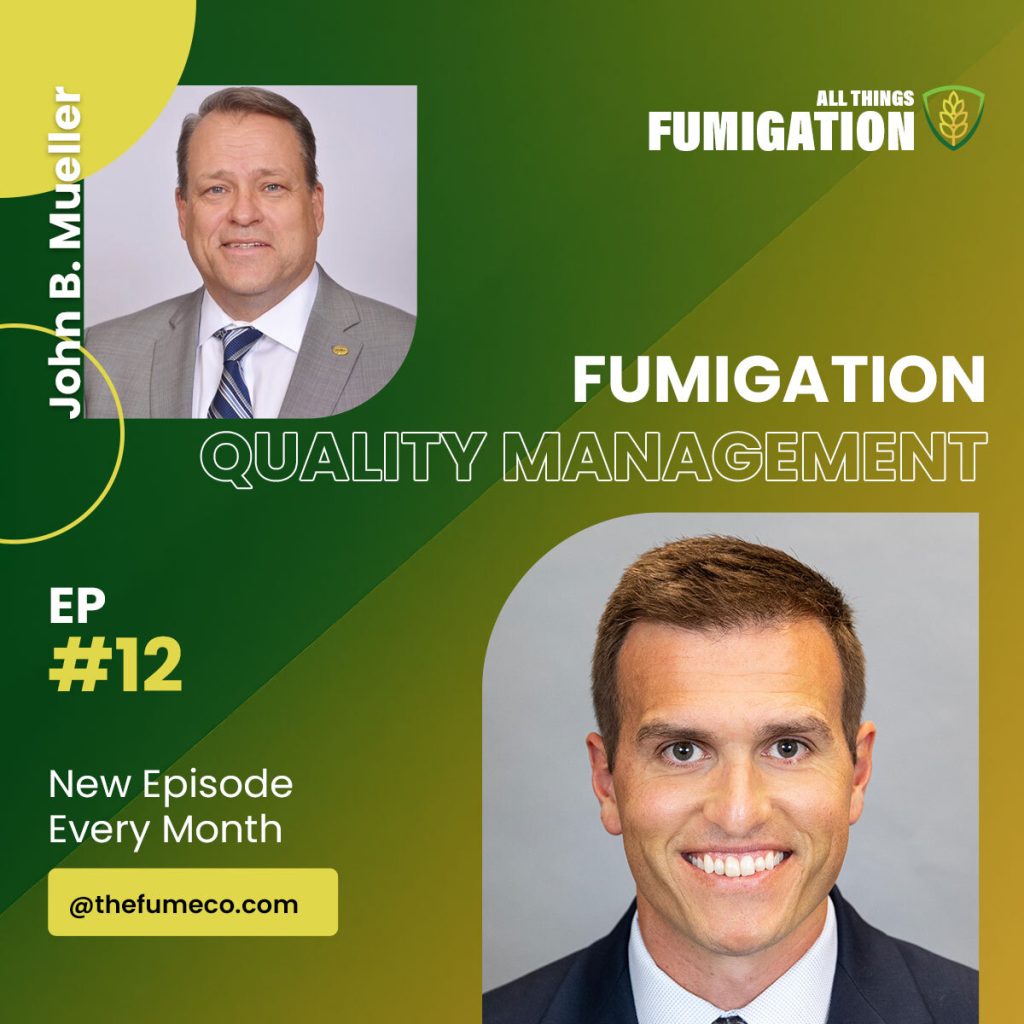
This Week's Guest
Tom Mueller
Tom Mueller of Insects Limited comes to discuss fumigation quality management in the food industry. He and John explore effective company culture, success traits of fumigators, and dive into the use of bioassays and pheromone monitoring to validate fumigations. He comes as guest moderator of All Things Fumigation, offering sharp insights and a family legacy rooted in the pest control trade.
Notes
Key Segments
[00:00:00] Focusing on results in fumigation
[00:05:49] Fumigation verification tools conversation
[00:08:31] Bioassay validation process
[00:11:01] Discussing fumigation strategies
[00:16:17] Pheromone monitoring in fumigation
[00:17:22] Need for pheromone trap standards
[00:21:28] Comparing pheromone release methods
[00:25:37] Monitoring pheromone trap data
[00:28:57] Proper use of pheromone traps
[00:30:49] Insect control in food facilities
[00:35:55] Counting flower beetle populations
[00:39:05] Effective fumigation verification process
[00:42:27] Pheromones beyond a commodity
[00:44:37] Podcast swag giveaway details
Host Bio: John B. Mueller has spent 40 years in the commodities fumigation trenches. He’s the founder of The Fumigation Company and host of All Things Fumigation, where he shares straight-talk strategies and science-backed tools to improve safety, compliance, and performance across the post-harvest and structural fumigation world.
LinkedIn Profile: https://www.linkedin.com/in/john-mueller-90499020/
Resources
Website: thefumeco.com
LinkedIn: https://www.linkedin.com/company/the-fumigation-company/
Email: John.Mueller@TheFumeCo.com
YouTube: https://www.youtube.com/channel/UC9xwkRSQm-vLn2q_IcQgpEQ
Commodities Fumigation Safety: https://nasdonline.org/7243/d002470/fumigating-agricultural-commodities-with-phosphine.html
Quality Assurance & Food Safety Industry News: https://www.qualityassurancemag.com/
USDA Fumigation Handbook: https://www.ams.usda.gov/sites/default/files/media/FumigationHB.pdf
Transcript
John B. Mueller [00:00:01]:
This podcast supports fumigators in improving safety, compliance, and solutions. Always follow the federal fumigant label, state, and local laws. Licensed fumigators are legally responsible for their applications. And now, on to all things fumigation. Out here, we don’t just fight pests, we outsmart them. This is All Things Fumigation, where applied science meets real-world grit. I’m John B. Mueller, a fumigator by trade and your guide to the science of fumigation done right. Each month we saddle up with the people, the practices, and the precision it takes to keep facilities safe, compliant, and pest-free. Because when you’re in the trenches of pest control, You don’t need magic. You need science and maybe a little cowboy spirit. Smarter solutions, safer practices, managed costs. Welcome to All Things Fumigation. Welcome to the next episode of All Things Fumigation. I want to thank you for joining us for this episode. Today we’re going to focus on fumigation quality management. I want to talk about some products and systems that can help you drive, verify, and validate your fumigations. And on our agenda, we’re going to start with quality company culture. We’re going to talk about quality people and attributes, good attributes for fumigators. We’re going to get into fumigation verifications. And we’re going to get into fumigation validation. So, let’s jump right into it right now. We’ve got a special guest today, so I want to move through the foundational components of this episode. But from a fumigation company culture, in the many years that I’ve been doing this, 40 years, I break fumigation companies down into 2. One, they’re results-focused, and the other is they’re revenue-focused. And in my opinion, if you’re a results-focused fumigation company, the revenue will come. If you’re a revenue-focused fumigation company, you have a mixed message to your team, and it’s easy to take the eye off of solving the customer’s problems when you’re worried about making numbers. And so results-focused is by far what I believe the best culture. From traits of a fumigator, success traits of a fumigator, I think, you know, I’ve hired a lot of fumigators over the years, and this is the list, in my opinion. If you are a commodity manager or a food safety manager and you’re evaluating this fumigator that’s coming into your facility, this is what I would review them against, right? So respect for safety is always a big one with what we do and anything we do. Driven to do things right is important. And I’m going to define that with, there is so much going on from a regulatory compliance perspective around fumigation that you have to be able to pay attention to that detail and focus on what’s doing right.
Tom Mueller [00:03:48]:
Right.
John B. Mueller [00:03:49]:
what you need to do correctly all the time. And then a strong sense of urgency is kind of universal to any service company, I believe. One that’s unique for fumigation and pest management in general, I believe, is scientific curiosity. It is a powerful trait that goes a long way in being successful in managing pests. And then high care levels, another Service, universal truth. And then the last one is get shit done attitude. And that one is particularly important because in the middle of the night when no one’s there to help you and you have issues going on and you have to figure it out yourself, you have to be able to trust in yourself using safe, good judgment, still doing things right, but you’ve got to get it done. And that’s where our mascot, the Science Cowboy comes into play. It’s that mix of scientific curiosity and that get-it-done attitude is where that comes from. I think some people think it’s my alter ego. It’s not. It’s to remind us that we have to follow the science. We’re applying the science in the field, and sometimes we have to have a little grit to get it done. So next, we’re going to kind of focus on the target, right? What is a successful fumigation? And then how do we build towards that? And we’ve shown this Venn diagram quite a bit. So if you think of the 3 circles in concentration over time as one, temperature as the second, and then pest density as the third, we know that if we manage these 3 very critical aspects of any fumigation properly, that we will have a high degree of success. Managing these 3 components is what makes fumigation the most powerful tool in the IPM, the Integrated Pest Management toolbox. So what are some tools, what are some assets that we can apply to both verify and validate this Venn diagram of fumigation success? Now, I know everybody that has consistently listened to the podcast is tired of hearing me preach about connected fumigant gas monitoring devices, so I’m not going to get into it again. But it is a reminder that gas monitoring is the first method of verification that we’ve followed our plan, that we’ve managed the gas concentration to meet our CT. So that’s your first level of verification. And then we’re going to go into a couple of other systems, which are use of bioassays and pheromone systems. And for that, we’ve invited Tom Mueller from Insects Limited, the president of Insects Limited, to join us, who is really one of the experts in this post-harvest market. And they supply bioassays and pheromone monitors and pheromones to the market. So I want to welcome Tom to the, to the podcast. And it’s very exciting. I know most of you understand Tom shares the same last name as I am. He is my nephew, and I’m very proud of him. And welcome to the show.
Tom Mueller [00:07:12]:
Well, I’m happy to be here. Um, you know, doing your FUME school a couple— what was that, about a month ago?
John B. Mueller [00:07:17]:
Yeah.
Tom Mueller [00:07:18]:
Um, it was one of the, the most, um, I wouldn’t say the most exciting talks that I’ve ever given, but it was the most— it was the best talk that I’ve given that helps to put purpose behind the true reason why we want to use some sort of a validation for using pheromones or validating that a fumigation is successful. So I’m excited to be here, keep talking about this.
John B. Mueller [00:07:42]:
Good, awesome. It’s important and that’s why you’re here. The one question I have is, is it Miller or Mueller?
Tom Mueller [00:07:48]:
I think that’s the question of the family, isn’t it? I use the last name Miller.
John B. Mueller [00:07:55]:
Yes. If my father was still alive, we’d all use Miller.
Tom Mueller [00:07:58]:
Yeah, that’s right.
John B. Mueller [00:07:58]:
Sometimes we get tired of spelling it all the time. So yeah, we have to get that one out of the way. I know that there’s a lot— I get teased a lot over that, but that’s okay. So I want to get into a little bit and ask you from a bioassay standpoint, I’ve always been very big on the use of bioassays with fumigation. And Insects Limited, you guys make bioassays and very custom— you have a very custom approach. Can you give us a little more information around that?
Tom Mueller [00:08:28]:
Around the custom approach that we take?
John B. Mueller [00:08:30]:
Yeah.
Tom Mueller [00:08:31]:
Yeah, yeah. Um, so, uh, bioassay is going to be something that you’re going to use to, to validate a fumigation post, post-fumigation. So, um, we want to make sure that we’re placing these bioassays, meaning live insects, which is weird to say— you’re taking live insects into a facility that’s trying to get rid of insects— but we’re placing those strategically around a facility so that we can validate that that fumigation was successful, i.e., seeing that those insects are actually dead post-fumigation. So some of the care that we need to take around that is to ensure that they’re not gonna blow away, so we use a dense card, if you will. And then we add food into the vial where we keep the insects, and then we make sure that that vial is attached pretty sturdily to that card so that it’s not gonna go flying around somewhere where you’re not gonna get that validation. needed after the fumigation is complete.
John B. Mueller [00:09:27]:
Yeah, so let’s make sure that everyone’s clear that keeping track of these bioassays are very, very important. I know one of the things that I like to do is to create kind of a double-blind check. And generally, we would order the bioassays, but we would give them to the customer to place. And we really didn’t want to know where they were. And so that to me is a way to to make the customer feel comfortable that if we killed everything, that it’s just a good process, good check and balance. You can also challenge fumigations. We’ve got pictures on the screen. I know some people are listening and not watching, but you can submerge these bioassays in flower material or place them behind shrink wrap, or I’ve had customers put them in boxes and seal the boxes back up. You know, it’s, it’s, it’s whatever it takes to make them comfortable that the investment that they made in this, this fumigation was, was worthwhile. So yeah, I’m very big on that. Now, what about— what’s your opinion of the majority of the market over the years has used red flour beetle as like a standard? I’ve always advocated for test your fumigation with the pests that you’re targeting. Do you agree with that? Is that, is that a good way to go? Is it advised?
Tom Mueller [00:11:01]:
Yeah, I think you could look at it both, both ways, honestly. I mean, the reason why people are picking red flour beetle is because it’s the hardest to kill. You have to have the highest gas concentration. So if you’re killing red flour beetles, then you’re going to kill your target pest. Um, on the other hand, you know, We’ve talked about start with the insect first and knowing what your insect is, and then planning your fumigation, your concentration needed, and the time needed based off of that insect. So if you want to get down to it, then doing the species-specific bioassay is going to be a great way to go. But I will tell you that the majority of the bioassays that come out of our lab are red flour beetle.
John B. Mueller [00:11:42]:
Yeah, it makes a good point. I mean, from a From a CT standpoint, just with, uh, sulfurofluoride alone, it’s, it’s the high— one of the higher ones. Um, phosphine seems to be more universally aligned, so as long as you’re keeping above those thresholds. So that makes a lot of sense. Yeah, and it keeps things easier. Um, so I wanted to get into another issue that was always important to me, and we’ve talked about on the podcast how difficult it is to kill the eggs. And, you know, most of these adults are dead within an hour or 2 of the fumigation. So any elaboration on managing mixed cultures on the bioassays?
Tom Mueller [00:12:22]:
Well, yeah, and I think that’s the reason why red flour beetle are so hard to kill, or you get the validation behind that, is because of the egg stage of that insect. There’s not a lot of holes that are in that where they’re being able to breathe.
John B. Mueller [00:12:39]:
They’re piles, right? Yeah.
Tom Mueller [00:12:41]:
Um, and having a mix in there is a great approach if you are very serious about this fumigation to, to validate it. Now what will happen is, um, a lot of times in what I spoke at, at your, at your fumigation school, um, holding on to these, these bioassays after a fumigation is complete, because what can happen is that female will dump her eggs And so you’re kind of, you’re getting your egg stage a little bit in there, not necessarily exposed to the fumigant, but for validating whether or not those eggs then mature through the life stages is a useful way to do that. If you’re mixing them, the different life stages within the bioassay itself, you’re guaranteeing that you’re having a successful fumigation all the way around.
John B. Mueller [00:13:28]:
Couldn’t agree more. No, it’s all good points. So you advocate, I advocate for the use of mixed cultures, mixed metamorphic cultures, really focusing on the egg. And we’ve talked about this before, but I think it can’t be mentioned enough. Where we’re seeing the challenges with fumigations is on that egg stage that has just been laid. So that female, when she senses something’s wrong with the atmosphere, there’s there’s fumigant gas coming in, she knows something’s wrong, she releases that egg, sometimes, most of the time prematurely. And if that egg can survive, it’s respiring, and it’s the most difficult to kill. I’m not going to say it’s respiring the fastest. That’s not necessarily true. But it is by far the most difficult to kill. And if that can survive, that’s where, you know, the fumigation performance lapse occurs. So there’s some other strategies around this we’ll talk about in future podcasts. But, but that is the reason we need to use eggs. And it’s also the reason we need adults in there. Because these, these bioassays will be shipped to you from Insects Limited. You’ll get them, it’s going to take a day or 2 or maybe a week before you use them. And those females are going to be laying eggs during that time. And you want that mixed array of eggs over that period of time, in my opinion. So, no, that’s really good, helpful information, I think. You mentioned holding the bioassays. How long do you suggest they’re held after the fumigation?
Tom Mueller [00:15:13]:
Well, we start with the insect first, right? So we understand what that insect’s biology is and how quickly it’s going to move through its life stages. And holding on to that bioassay for 3 weeks is a pretty good indicator of whether or not you’re having an emergence out of an egg into a larva to verify whether or not the gas had actually reached that egg.
John B. Mueller [00:15:36]:
Yeah, I agree with that. And room temperature I think is fine, don’t you? Yeah, it’s fine. Yeah, keep it by your desk, observe it, set your calendar to look at it after about 21 days. That’s gonna tell you a lot. And that’s your next level of verification. So now you have gas readings. If you’ve done those properly, you’ve got bioassay analysis. And now we’re gonna go into some other things here.
Tom Mueller [00:16:02]:
You wanna know something that’s pretty funny though, after a busy season?
John B. Mueller [00:16:05]:
What’s that?
Tom Mueller [00:16:06]:
Walking into a fumigator’s office and seeing all the bioassays stacked up on their desk.
John B. Mueller [00:16:11]:
The corpses, right? Yeah, yeah. I like that. I like that. Good picture of that.
Tom Mueller [00:16:15]:
Right.
John B. Mueller [00:16:16]:
All right, I want to ask the listeners and the viewers to give us a like on your streaming network. And as you know, we want your feedback and would like some suggestions on future episodes. So appreciate your likes. Next, we’re going to get into with Tom a really important aspect of fumigation quality management that I always leaned on pretty heavily, which is Pheromone data, and pheromone catch counts, and pheromone monitoring systems in the facilities when we’re fumigating for stored product insects. And I know most of the listeners and viewers understand what pheromones are and what pheromone traps are. But we want to get into maybe and challenge a little broader view on how these can be an important tool in quality analysis and validation for fumigation. Now, it depends. All of this depends on how these pheromone monitoring systems were set up in a facility. There’s good data requires effective tools, right? Effective pheromones and proper collection of that data. And what’s frustrating to me is we have systems in our facilities that dictate rodent control programs. They identify that, you know, rodent control traps need to be on each side of the door and so many feet on interior traps and so many feet on exterior traps. And there are standards around this, but we don’t have standards around the use of pheromone traps. And if you think about it, you know, yes, there are fumigations for rodent issues, but the majority of the fumigations post-harvest that are going on are centered around insects. So why don’t we have the same rigors built into our pheromone systems that we do our rodent systems? So I want to kind of tee that up for Tom, who is a manufacturer of pheromones, pheromone traps. I want to kind of tee that up for him and get his feedback from his perspective as a manufacturer.
Tom Mueller [00:18:31]:
Yeah, um, we— you, you said a lot there and a lot that hits pretty close to home. And, um, you know, I don’t, I don’t remember exactly what the guidelines are for having pheromones in a food facility. They’re all there. It is mentioned that there should be a pheromone monitoring program, uh, present, right?
John B. Mueller [00:18:53]:
Yeah.
Tom Mueller [00:18:54]:
But it doesn’t dictate as much as it does from a rodent section of it. And to be honest with you, I wish it did. It’d make my job a little bit easier. I’m constantly working with companies trying to either pull them along into understanding the best ways to use pheromones, because you already said the S-word on here, right?
John B. Mueller [00:19:15]:
Yes.
Tom Mueller [00:19:15]:
Yeah, so it’s shit in, shit out, right? So if we’re— if we are— and the reason, you know, I’ve— over the past couple of years, I’ve kind of gotten Mm-hmm. Soured on the word monitor. And I like the word because it doesn’t have any regulation with it. We’re not claiming control of a population of insects like we are with fumigations or other types of insecticides or applications. But the word monitoring to me gives pest control managers the excuse to just stick one out in a facility and say, I have insect monitoring going on. And I don’t believe that’s the right way to do that. And I constantly try and work with companies to ensure that they understand that these items, these devices are to help you make decisions on your program. And we’ve narrowed in today that we want to talk about validating fumigations, verification of a successful fumigation and quality. But it goes for anything in the pest management industry, right? We want to validate whether or not the decisions that we’re making in our pest management program are working or are they not working. And having a pheromone program, when you’re talking about insects, having a pheromone program used properly gives you that, right, the correct data to make those decisions, right? When it comes to fumigation side of things, you know, it’s, it’s, it’s a baseline. We want to fumigate, or we want a pheromone monitor before fumigation, and we’re going to get a baseline of what the insect activity is like before we actually introduce gas into the facility. After the fumigation, we can compare our catches to that baseline, and that’s where the true, the true validation comes into that, that program.
John B. Mueller [00:21:04]:
100%. And I think too, you mentioned and I mentioned the importance for accurate data collection. Right. I know you’ve got some information, and again, listeners, you’re going to have to kind of walk through with listeners that aren’t viewing, but you wanted to really kind of focus on some accuracy attributes. Yeah.
Tom Mueller [00:21:28]:
Yeah. So I have a graph that I have given to John here, and this was a study that was done out of Italy on the difference in pheromone monitoring devices and the release of the lure, the release of the pheromone into an atmosphere. So I’ll try my best to explain this for those, those that are listening. But what I have here is a graph with 2 lines on it, and both lines are descending down and to the right. What we’re seeing here is the researchers in Italy used a mass spectrometer to measure nanograms of pheromones that are being released at certain days and at certain concentrations. And on one line we have a vial that is being used, and a selfish plug, Insects Limited uses something called a bullet lure. We manufacture something called a bullet lure, which is a vial with an exact dose of pheromone in it, with a steady constant release over time to give us the data that we want. The other line on this graph is what we call absorption, right? So These pheromone dispensers absorb pheromone, say it’s a rubber lure, absorbs the pheromone into that rubber, and then it releases that pheromone, but is at the mercy of what’s going on in the environment. And what this graph is showing us is that over time, the deviation of how much is actually being released by the 2 different pheromones tells a big, big story. So of the absorption-style pheromones, the, the standard deviation could have been 200 nanograms or it could have been 1,000 nanograms, okay, at the same day mark, same lure, same day mark, right? Well, to, I guess, wrap this up, to put a bow on it, if you have one pheromone that’s releasing more pheromone, or one lure that’s releasing more pheromone, you’re going to get a little bit better attraction. But if you have the same style of lure in a different area that’s releasing less amounts of pheromone because of the type of lure that it is, your attraction doesn’t show up as well, right?
John B. Mueller [00:23:40]:
So you’re—
Tom Mueller [00:23:40]:
the data that you’re getting isn’t consistent. And so you could be thinking, oh, I, I’ve done a good job and I’ve gotten rid of the pest problem, when really your pheromone lure wasn’t releasing a whole lot of chemical to attract those insects. So A little hard to describe the graph and what we’re seeing on the screen here, but I guess the gist of it is consistent pheromone release is ever so important to help you make decisions on what to do next in a pest management program.
John B. Mueller [00:24:10]:
Yeah, clearly Tom is a true science cowboy, so I’m going to take it from his laboratory to the field and share a story with you. We’ve got another graph, I’m sorry, but I can Yeah. But we’ve got another graph, and this is circa 2014 when we were doing a lot of detailed pheromone monitoring. And what was interesting is at this facility, I had been called in prior to this data, and they needed to do a fumigation for cigarette beetle. And we were going around sizing the facility up, doing an assessment of the site. And there were cigarette beetles everywhere. And I noticed that they had some pheromone traps. They looked a little strange to me. And I walked up to the pheromone traps— trap, first one, right by what I thought was the source of the infestation. And there was no beetles in the trap. And I looked at the last date of service and it was 6 days prior. And it was bizarre to me. And when I questioned the site why they were choosing these traps, they said that they were They were the cheapest. And when you’re collecting data, and Tom said this, when you’re collecting data and you’re going to make decisions from that data, you have to have good data. And it’s brutally important to be, you know, discriminative around your purchases here. You need these. This is not going to break your, your, your budgets and your commodity site or your food processing site, it’s very important to collect that accurate data. I also agree with something that Tom said earlier too, around, you know, people tend to put a few pheromone traps out so they can say they have a pheromone monitoring system, and they are just missing the opportunity that’s described in this operation here. We’ve got something— the graph shows something like 50 pheromone traps, and it kind of is overwhelming, right? You look at this, where do you start? There’s a lot of catches. They have a lot of activity. And what we would always do in our programs is we would just take the top 3, right? We would just look at the top 3 traps. We’d inspect around that area. We would look at ingredient that might be there or finished product that might be there and try to find and understand that source. And we would do things like help direct or suggest cleaning if cleaning was the deficiency. It helped us understand hotspots on how we would treat and when we needed to treat. We were able to catch suppliers sending infested material in. From a fumigation preparation standpoint, we were able to establish pest density, which helps us be more effective and manage to that. And then post-treatment validation, like we mentioned. So, you know, that— this is what facilities are missing, is the power. of this data to help you manage your stored product pest challenges and populations. It is a critical tool and really the difference between, you know, a well-managed food safety program related to insects and a poorly managed one. Anything you want to add to that? I know I kind of went on a little bit there, sorry, but it’s something that I’m a little passionate about. Over the years.
Tom Mueller [00:27:36]:
Oh, you can’t— I mean, you can’t tell me that pheromone monitoring isn’t sexy, right? I mean, look at— look, you got a list of 6 things right there of what it can do to, to make you, one, a better pest manager, a better fumigator, and 2, to help your customer, right? You, you mentioned that you went in and asked why you— they were using a certain pheromone that they did, and they said it was, it was cheaper.
John B. Mueller [00:27:56]:
Yeah.
Tom Mueller [00:27:57]:
Well, that takes you back to your slide of, are you doing what the culture— are you, are you Doing it for revenue or are you doing it to help your customer?
John B. Mueller [00:28:04]:
Results or revenue.
Tom Mueller [00:28:05]:
Right, right. Well, that didn’t help the customer.
John B. Mueller [00:28:08]:
Well, I reminded the person— I left this out— I reminded the individual, uh, because he kind of went on a rant about how expensive pheromones could be. And I said, I’m in here assessing a fumigation that’s going to cost you probably $100,000. And if you could have managed this a little more— I didn’t say this, but if you could have managed this a little more effectively, I wouldn’t be in here ready to lay down a 6-digit bill to you. So, I mean, there it is right there.
Tom Mueller [00:28:34]:
Well, I think the beauty of that too is that it doesn’t mean fumigation has to go away, but working together with that facility manager, you guys could have pinpointed the areas that are a little bit out of control and need that reset and still been able to give them the reset that they needed, but not put a price tag on it for the Yep, that’s exactly right. Helping the customer.
John B. Mueller [00:28:56]:
And, you know, I think, I think some of the confusion too, I’m going to defend the market here, and in this case, food safety managers a little bit, because where the confusion comes from is how to use these pheromone traps efficiently. And, you know, we could do, you know, a whole podcast series on effective use of pheromones, but I don’t think we can discuss this like we are without some context. And, you know, if you think of a food processing facility that’s linear, right, it’s ingredient coming in the left side of the facility, processing is in the middle, warehousing of finished products on the right side going out, right? Is there’s different strategies that I feel, and Tom, you, you add whatever you think here, but where I want to have a tight grid system of pheromone usage is on that That inbound ingredient. I want to catch anything that could be infested coming in. Now, and that’s going to be a tight grid. Now, in the processing areas, there’s a lot of activity. It’s very difficult sometimes to, you know, to find a good place to place these traps. But it’s also important to have pheromone traps in these areas because you’re kind of grading the cleaning. Or the cleaning inadequacies based on what kind of pest populations you see. And then on the outbound warehouse side, you want to protect that area. So if activity in the receiving side or the processing side starts to move out into the branded, precious, you know, finished product, you have to know that too. So, and that might be a tight or loose grid. system of placing these traps. Does that sound in line with your thinking and your philosophy as a business owner?
Tom Mueller [00:30:48]:
Oh, 100%, because if you look at that chart or that diagram schematic of the facility, the insects are going to follow the commodity, right? You do have kill steps along the way in the processing area, processing of the food. But in receiving, if you’re introducing them from a vendor, And you’re, you’re just, you’re getting behind from the get-go, right? Also, you might see pests, different pests along the way, and that can tell you a different type of story as well. So when you get more towards the warehousing section, and if you’ve got, if you’ve got some spillage or some debris in there, you might be looking more at Indian meal moth, where on the, the, um, receiving and processing side where the dust is gathering, you could be looking at the flower beetles or some of the crawling beetles at that point, too.
John B. Mueller [00:31:40]:
Yeah, I think that’s important, too, because it’s usually not one pest, right? There’s usually, you know, a vertical, and then sometimes rodents are near the bottom in many cases. But to your point, it may be, you know, 2, 3, 4 different types of insects. We know there are only 13 to 20 store product pests that really focus on most of what we’re doing here.
Tom Mueller [00:32:05]:
And each pest is going to call for a different— we talk about being a science cowboy, you got to know the insect. It’s going to call for a different strategy on how to mitigate it and a different strategy on how you’re going to monitor for it as well, whether it’s a floor trap or a hanging trap.
John B. Mueller [00:32:20]:
That’s a good segue because I have a pet peeve. That’s why I brought the one this brought up. So thank you. So give me your thoughts on wing traps versus floor traps.
Tom Mueller [00:32:32]:
Extremely useful tools, obviously, but to be used very differently. There’s only a little bit of crossover. The trend that we see right now is multi-species, right? Historically, it’s been species-specific. Let’s make sure we know what we’re getting. And, but now everybody wants a multi-species lure. So for your hanging traps, your wing traps, a lot of different names for those guys. Um, you’re looking at the main insects of Indian meal moth or other types of food moths, warehouse beetle, and cigarette beetle, right? On your floor traps, it’s more of a mixture of pheromone between sex pheromone, aggregation pheromone, and a food attractant. So you’re getting primarily, um, more insects that are going to be strictly crawling insects with them. Um, there is crossover with them, but you also need to know the pests and, and how far they’re willing to travel. Hanging traps are going to be for those flying insects. They use a sex pheromone to communicate. They are good at traveling and good at finding that pheromone. Example, red lady— or I’m sorry, red flower beetle. They can fly, but we do not use hanging traps to monitor for red flower beetle. They’re not going directly to a source because they use an aggregation pheromone, not a sex pheromone. They’re just coming to an area. Right. So very different types of devices there, different types of pheromone being used inside those devices. And understanding that insect’s biology and behavior and how they act is going to help you get ahead when setting up this program.
John B. Mueller [00:34:07]:
Yeah. And I see too, too, I see too many people using wing traps, you know, on beetles. Yes, they fly. In the case of red flour beetle, they fly only in certain circumstances, when it’s really warm. And I was in a tobacco operation one time, and they were all happy that their counts had dropped, and it was like 62 degrees in the warehouse. Well, the cigarette beetle weren’t flying anymore. They still had a problem. And we changed to floor traps, and we started to catch quite a few on the floor, and they still realized they had some issues. So, I mean, you have to, you know, again, it’s around the biology. So yeah, I think sometimes, you know, if you’re scientifically curious, use both. You know, Indian meal moth wing traps for sure, you know, to your point, warehouse beetle too, but they can be impacted by cooler temperatures, but sometimes use both.
Tom Mueller [00:35:05]:
I love your example of the cigarette beetle. One, they like to fly to an area, land, and then crawl. Right? So a lot of times it can be pretty effective on a flat wall or something like that. But using both of those styles of traps came in handy. Even when the temperature was fine, we had a wing trap hung with multi-species and we had a floor trap directly below it. And there was only one cigarette beetle in this trap. And on the floor trap, there were hundreds.
John B. Mueller [00:35:36]:
Yeah.
Tom Mueller [00:35:37]:
And if we were only using the wing trap at that particular facility or that particular area, we would have missed a big infestation that was going on about 10 yards away in a box of cigarette beetle because we’d have been like, oh, it’s just one.
John B. Mueller [00:35:49]:
Yeah.
Tom Mueller [00:35:50]:
But using the other one, knowing it was cigarette beetle, we used both.
John B. Mueller [00:35:54]:
You know, and you— I haven’t asked you about this, but, you know, one of my thoughts is when I was going around counting flower beetle traps, I didn’t necessarily just count what was in that trap because they were aggregating. A lot of times, if you notice, you’ll see flower beetle immediately around that trap. or right up on the wall above it, I would count everything that I saw after I put a thumb on the rest of them. But to me, why are we drawing a hard line on what’s in the sticky material, the oil material, or whatever it is? It’s what has drawn that in, and I want to understand the population of that area. So I don’t know if you have an opinion on that or not.
Tom Mueller [00:36:35]:
Yeah. You know, flower beetles are a lot harder to pull out of, of what they’re infesting. There’s already food, there’s already aggregation pheromone from other insects that are, that are there. Um, so I mean, you may get 2 in a trap, and that’s a worse indication than getting 15 to 20 Indian meal moths in a hanging trap.
John B. Mueller [00:36:55]:
Yeah.
Tom Mueller [00:36:55]:
It may be a bigger infestation. I like your idea of counting the insects that are around it because it is an aggregation pheromone. It just pulls them to the area rather than getting them— I mean, we’ve seen warehouse beetle trying to crawl through insect— through glue to get to the lure because they want to get to that endpoint, but they’re stuck in the glue. The flower beetles will just gather in the area. So really effective as long as you can be consistent with that, as long as it’s not messing up your data by counting at one time, not counting at another.
John B. Mueller [00:37:25]:
Yeah, yeah, true, true. Well, look, we’re gonna summarize this because we could go on quite a bit. But I do want to describe another graph for the listeners. You know, it’s a linear graph over about 4 months almost. And it shows insect catches coming up to a fumigation event. And then after that fumigation event, about 23 days later, We start to catch adults again, and this really to me illustrates the power of reviewing your fumigation, you know, and the importance of verification and validation. A fumigation should last more than 23 days, right? So obviously there was an egg ding. We had no adult catches in those pheromone traps, right? Eggs aren’t going to, you know. sprout legs and walk over and get in that trap. It’s going to be an adult that makes it there. So it took them about 21 to 23 days to emerge, and then they started catching them again. And when we’re evaluating that fumigation, we’ve got to focus on that. What was missed, right? So when we verify, when we talk about our gas readings and our temperature readings, that’s a verification step, right? We’re verifying that we followed the plan and we met the CT, the concentration over time. And that is an important step, right? And the next verification is using bioassays. In this case, they used egg, larva, pupa, adult mixed cultures in food. They did things properly, and nothing had emerged in that. Now, keep in mind, the reason I call that a verification step is in the location that that bioassay was placed, the fumigation was very effective. And it gave us a level of— another level of confidence. But from a true validation standpoint, the proof is in the performance over time. And that’s what good pheromone monitoring systems give you, is you can’t hide, right? You don’t know where these harbors are. Was it a structural issue that the fumigant was challenged with? Was it a supplier-driven issue? You don’t know until you start to take that data. And now what I would do from there is to find out where those initial catches were, where that location is, and start to really be scientifically curious around where did it come from. And to me, this is the power of driving Very, very effective fumigations. I’ll shut up.
Tom Mueller [00:40:11]:
No, no, I agree. I think, you know, a point I’d like to make is that fumigation shouldn’t be viewed as the end of the pest management process, right? It resets the population. It helps get it back to zero. But facilities that find the most value in from fumigation, establish a monitoring program and a good monitoring program because it’s going to point to those different areas. You know, one thing we didn’t mention is being able to use pheromones to pinpoint those, those structural areas that may have issues.
John B. Mueller [00:40:48]:
Yeah.
Tom Mueller [00:40:48]:
Or pheromones can point you on how to, to a, in a direction on how to, um, the next time it’s, you’re going to do a fumigation again, point you in a direction on how to Change it up, right?
John B. Mueller [00:41:01]:
Yeah, yeah.
Tom Mueller [00:41:02]:
And prove it.
John B. Mueller [00:41:03]:
Yeah, absolutely. Yeah, absolutely. And that’s the whole purpose of it, is, is, is erase what went wrong, find out what went wrong, eliminate it, and look at, look at what was successful and repeat that. So I completely agree. Hey, look, I wanted to give you an opportunity to, to plug Insects Limited. I’ve got on the screen here, if If anyone wants to get ahold of Tom, it’s tom.mueller@insectslimited.com. And you can go to their website, insectslimited.com, and look at the products that they have. And I think you’ll find some pretty cool support features there as well. So I want to let you kind of represent your business.
Tom Mueller [00:41:48]:
Yeah, absolutely. And I appreciate that. Look how pretty that picture looks up there. Everything you need for food commodity fumigation or food commodity pest management monitored in, you know, 3 to 4 different types of devices there. You know, Insects Limited, we’ve been around since 1981. And I love the term science cowboy. I love the idea of keeping science at the forefront because that’s what Insects Limited has done from the very beginning. The, the 4 things that make us unique are science, education, innovation, and quality products. And my biggest fear when it comes to pheromones is that, that I’m going to talk to somebody who views a pheromone as a commodity and not get the value that Insects Limited is trying to provide to the industry. And when I say value, I don’t just mean the highest quality pheromone available on the market. I actually mean the value-added information that we’re going to bring along with you to make you successful in what, in what you’re trying to do for your customers, right? So we have a whole program that we call Insights to Impact where our entomologists are studying these insects, studying how they interact with, with the pheromone monitors, studying how they’re interacting within the environments, and then we’re creating those insights and making an impact for our customers with that. So, so not just a commodity, you’re not just buying a pheromone from us, and Yeah. If that’s what you want to do, you know, I might get my hand slapped for this back at the office, but I don’t necessarily want to work with you. I want to work with somebody who’s going to be using a pheromone program to gather data and make decisions, and they understand that our quality pheromone is giving them the, the consistent data needed to make those decisions. And on the back end, they can call us with any questions. We’re going to provide any type of information that we have Um, to help them be successful.
John B. Mueller [00:43:43]:
You want to work with people that want to drive results.
Tom Mueller [00:43:45]:
Yeah.
John B. Mueller [00:43:46]:
Yeah. I like that.
Tom Mueller [00:43:48]:
I, I— can I just tell a quick story? I get a little— I get in a little trouble at trade show booths because we’ll have somebody come up and I’m just like, tell me about your pheromone program. And they’re like, oh, we, we stick some out and we, we know whether or not we’ve got insects or not. I’m like, I don’t think this is the booth for you. I think you need to keep walking. There’s some other people here who might want to help you with that, but we’re here, we’re We’re here to make you better.
John B. Mueller [00:44:07]:
Yeah. Well, like anything, like you said, good data in and good decisions out. So that’s critical. So on that note, that’s another good segue. Be a science cowboy, apply the science, and protect your product. I want to ask you guys again to give us a like on your streaming network. I want your feedback. I will say from a feedback standpoint, anybody that I’m going to start encouraging people a little more. We’ve got some The Fumigation Company swag here, so we’re going to start giving hats out. I even might give one of the rare Science Cowboy bobbleheads out if somebody really has a fantastic question and might want to join us on the podcast to explore that idea, that case example. So anybody that gives us feedback, we’re going to send you some swag if we play it on one of the next podcasts. I want to thank you again for joining our podcast. I am John B. Mueller, a fumigator by trade and your guide to the science of fumigation done right.