
Intro to Ethyl Formate: The New Kid in the Toolbox Part 2 | Episode 6
Game-Changing Fumigants for Safer, Faster Pest Control
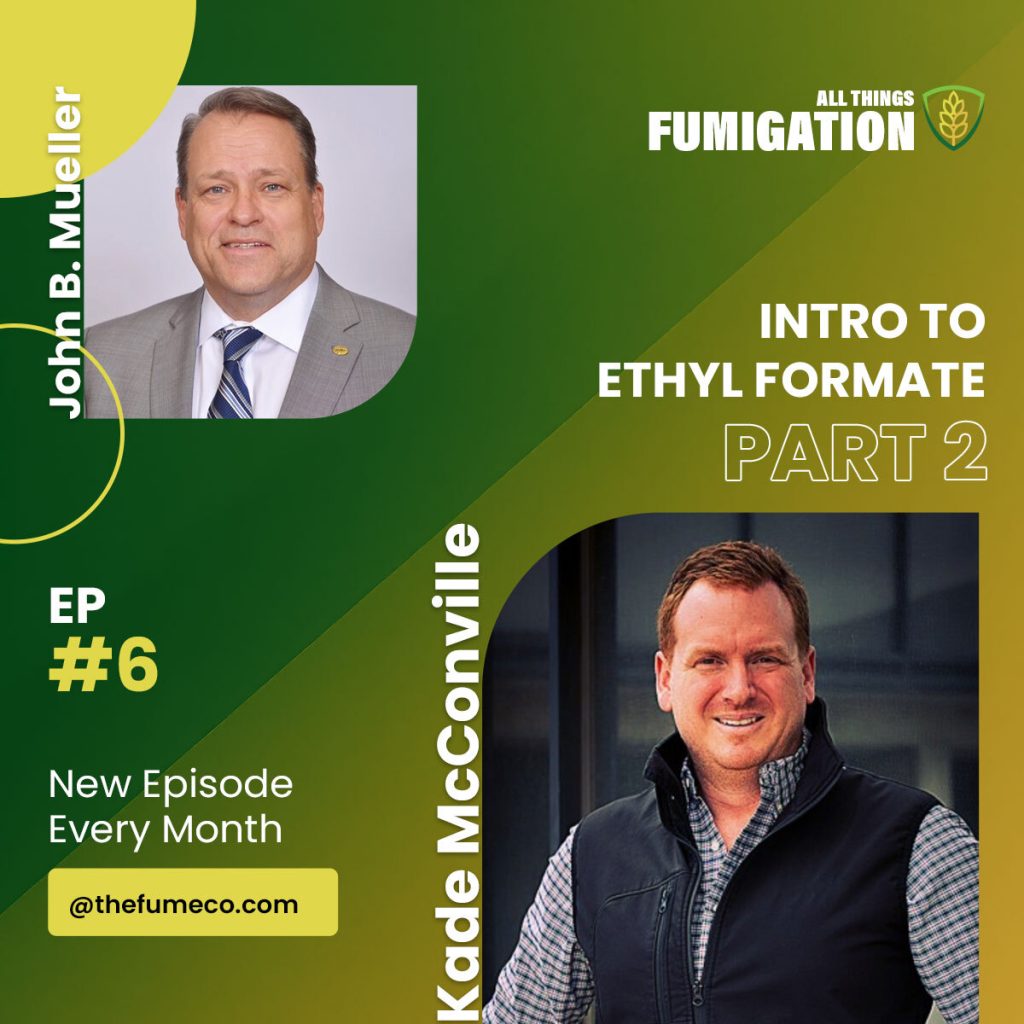
Episode 6 of All Things Fumigation brings together host John B. Mueller and guest Kade McConville, executive director of the Intreso Group, for a more in depth look into eFUME®, the latest ethyl formate-based fumigant. Kade McConville recounts the seven-year journey through US registration for eFUME®, emphasizing the investment of time and resources required for modern regulatory approval.
The conversation highlights ethyl formate’s favorable safety profile, including its GRAS status and lack of concerning residues, and details the specialized application equipment designed to handle its flammability and pressure hazards. Regulatory differences across countries are addressed, as well as the process of expanding the US label for broader commodity use, including treatments for brown marmorated stink bug (BMSB).
The episode also explores how eFUME®’s costs align with existing fumigants when considering dosage rates and operational efficiencies, such as faster treatment times. The potential for eFUME® as an organic solution is discussed, with ongoing efforts to source ethyl formate naturally for future certification. Key takeaways include the importance of industry support for successful adoption, the need for collaborative feedback, and the exciting role ethyl formate could play in sustainable and organic pest control practices.
Notes
Key Segments
[00:00:00] Part 2: Intro to Ethyl Formate: The New Kid in the Toolbox
[00:05:50] Seven-Year Registration Journey of eFUME®
[00:08:35] eFUME®: Product Hazards Explained
[00:13:06] US Key Commodities Focus
[00:23:35] Ethyl Formate Supply Challenges
[00:26:47] Promoting New Fumigant Globally
[00:28:44] Access to a new Substance
Host Bio: John B. Mueller has spent 40 years in the commodities fumigation trenches. He’s the founder of The Fumigation Company and host of All Things Fumigation, where he shares straight-talk strategies and science-backed tools to improve safety, compliance, and performance across the post-harvest and structural fumigation world.
LinkedIn Profile: https://www.linkedin.com/in/john-mueller-90499020/
Resources
Website: thefumeco.com
LinkedIn: https://www.linkedin.com/company/the-fumigation-company/
Email: John.Mueller@TheFumeCo.com
YouTube: https://www.youtube.com/channel/UC9xwkRSQm-vLn2q_IcQgpEQ
Transcript
John B. Mueller [00:00:01]:
This podcast supports fumigators in improving safety, compliance and solutions. Always follow the federal fumigant label. State and local laws licensed fumigators are legally responsible for their applications. And now on to All Things Fumigation. Out here, we don’t just fight pests, we outsmart them. This is All Things Fumigation, where applied science meets real world grit. I’m John B. Mueller, a fumigator by trade and your guide to the science of fumigation done right. Each month we saddle up with the people, the practices and the precision it takes to keep facilities safe, compliant and pest free. Because when you’re in the trenches of pest, you don’t need magic, you need science and maybe a little cowboy spirit. Smarter solutions, safer practices, managed costs. Welcome to All Things Fumigation. All right, welcome back to All Things Fumigation. And this is episode 5B, or maybe episode 6. In our last recording, we had a really kind of a special segment on Ethyl Formate. I went through some of the basic foundational aspects of ethyl Formate and then we interviewed a post harvest researcher, Dr. Spencer Walsh, with UC Davis, and we also interviewed another individual and the podcast went very long. So we decided to break this up into really two podcasts because there was just so much information, really, even just from a foundational standpoint. We’re going to get into our next person that we’re interviewing, and I think you’ll find this to be enjoyable. I want to take a moment. If you find this episode helpful, please like us on your streaming choice. Greatly appreciate that. That helps us out a lot. And we’d also like for you to give us your feedback. We want to take those suggestions. We want your suggestions for what’s important for future episodes and future programming. So don’t be afraid to email me, call me, make suggestions, but we really want that. We’re going to start sharing that on the next episode and we’ll give you a shout out as well. Our next person that we’re going to be interviewing is another good friend of mine is Kade McConville with the Intreso Group. Kade is the executive director and is also a director of Drozlavka Agricultural Solutions. So these are the two companies that have worked very hard and spent a tremendous amount of money bringing this new fumigant tool, eFUME®, to us, Ethyl Formate. And we want to get a manufacturer’s perspective now that we’ve had Spencer as a researcher’s perspective. So I want to welcome you to the podcast and I Will say I think Kade is a better skier than Spencer is so I’ll throw that out there and he’s probably a better dart thrower as well. Welcome. Welcome.
Kade McConville [00:03:23]:
Great intro, John. Great intro. Thank you very much. Thanks for the opportunity for this. It’s going to be fun. Yeah.
John B. Mueller [00:03:31]:
No, I’ve known you for quite a while. I think we go back to St. Elmo’s Steakhouse in Indianapolis when West Purdue to another good friend of ours introduced us at that time and then we came back together a few years later and you’re still in this strange post harvest fumigation realm.
Kade McConville [00:03:47]:
Joining the circus. Still in the circus.
John B. Mueller [00:03:49]:
John, we haven’t scared you off yet.
Kade McConville [00:03:53]:
That keeps on giving most of the time.
John B. Mueller [00:03:56]:
Yeah. So yeah. Welcome to all things fumigation. We really appreciate it and I know it’s very early in Melbourne for you right now but want to get your perspective on your product and see if you can give us. We’ve got a little research history from Dr. Walls but we want to get product history from the manufacturer’s perspective so we can kind of understand the origins of eFUME® and ethyl formate.
Kade McConville [00:04:22]:
Yeah, for sure. So I think look just as some background as you as you introduced, John. I’ve been involved with Draslovka, a multinational chemical manufacturer based out of Czech Republic for 10 years. But I’ve been involved across the sector for close to 15 years now mainly on the product development side. So not so much on the actual chemistry side but on the commercialization side of the business. So we have always been a company which is focused on basically the full supply chain and the vertical integration of products all the way through to the end user. And Drazlovka and Intreso Group, Intreso being international treatment solutions, have really been managing three core products over the last few years but really we’ve really seen a ramp up with eFUME® and ethyl formate based products, let’s say over the last nine to ten years as we’ve been predominantly working on the US registration itself. So we’re in a unique position right now as you’ve covered with Spencer and in the last segment. We’re at a tipping point now and I think that this is a really exciting opportunity for the global markets for fumigation but particularly with something like ethyl formate like Spencer explained, it’s a game changer that we see.
John B. Mueller [00:05:46]:
Yeah, I agree. And it’s been long needed. Right. One of the things I wanted to kind of point out I think is how long was it that you registered, you were in the registration process with ethyl form 8 in the U.S. yeah.
Kade McConville [00:06:03]:
So we were in the registration process for approximately seven years. So we’ve invested a lot of time and effort into it and I’ve got a lot less hair and it’s a lot grayer because of it. But I think that we’ve really got to a point now now where you know, that we’ve now got a dossier, you know, for those who don’t know. A registration involves a huge amount of data, particularly for products which are 21st century fumigants. You’ve got a lot of, let’s say, products that are on the market which, which have a number of data gaps, but they were things that were registered a long time ago. You can imagine now with the world that we live in now, the, the amount of data, documentation, studies, everything that we need to present to get a registration across the board is astronomical. So, and that’s, that’s included a huge amount of investment from our side, particularly on the health and human element of the product, but also on the efficacy as you, as you touched on with Spencer before. So, you know, whilst it’s been a very lengthy process and involved a lot of resources from our side, you know, I think that the, the actual cost itself, both in, both from a cash perspective but also from a human resources perspective has been, has been very high.
John B. Mueller [00:07:14]:
Yeah. And thank goodness there weren’t concerning residues. You know that that part is usually the hard part with, with new chemistry introduction. So that one was an easy one.
Kade McConville [00:07:23]:
From, from our perspective. It was also very interesting because the we, we had to take a certain calculated risk throughout the whole registration process that that may not have been the case, that the fact that we got, the fact that we got a substance approved by the US EPA, by the USDA with no RLS in the 21st century is phenomenal.
John B. Mueller [00:07:48]:
Yeah, no, I agree. I don’t know if everybody quite understands, but exempt from residues is a huge issue and it’s really going to play into more discussion around organic options for this product that we’ll get into a little later, but that’s something I’m particularly excited about. But you talked about a lot of the work went into the safe handling of your product and that’s, you know, bystander safety, operator safety, safety applicator safety. You know, we really want to make sure. And I’ve been impressed by a lot of the items that I’ve read on your label. Can you kind of go over with the listeners on how safety is managed when handling eFUME®.
Kade McConville [00:08:35]:
Yeah. So in the end you’ve got a couple of main hazards with eFUME® as a product. So firstly we have to differentiate, differentiate between ethyl formate and eFUME® as ethyl formate being the active substance, eFUME® being the actual product itself as a mixture with or a formulation with, with carbon dioxide. So if we look at eFUME® as a, as a formulated product, we, we’re dealing with, we’re dealing with high pressure gas, we’re dealing with, we’re dealing with cold substance where we’ve got two substances that are in the same cylinder which, which are very chemically different to each other. They also vaporize at different rates. So we’ve needed to design the equipment around and as Spencer mentioned before, also flammability. Flammability is a big concern with this product. And I think that the, the flammability we have mitigated by the, by the formulation with CO2. And we’ve, we had to do a huge amount of work in behind the studies, et cetera to be able to use it safely and effectively in the field. But that also transposed across to the equipment itself. So the equipment that you use for the application of eFUME® is not just plug an eFUME® cylinder into a methyl bromide vaporizer and away you go. This is specialized equipment that we have patented. We’ve done the work in behind it to ensure that we’re able to deliver the product safely into enclosures. Whether that be again, from our side, it’s more than just the infield applications, but it’s silos, it’s warehouses, it’s containers. Anything that you can, anything that fumigate. Now you can fumigate pretty much with, with ethyl formate based products.
John B. Mueller [00:10:18]:
Just, just to be clear, you can’t, just to be clear, you can’t put ethyl formate through a turkey, turkey fryer like you do with methyl bromide. Right. It’s a, it’s a very specific vapor. It’s a very specific vaporizer. I want to, I want to emphasize.
Kade McConville [00:10:32]:
That, yeah, it’s a very specific. If you go and put this through you like there won’t be much left to be honest. So I think that we need to be very mindful that, that we, that we focus on the fact that, you know, the equipment itself. We’re working with a number of US manufacturers, we’re also working with, we’ve got our own patented equipment from Australia, but we also work with, with different players globally. If they’re interested in, in building their own equipment or bringing their own equipment to market to facilitate the use of eFUME®. I say go ahead. You know, we’re more than happy to. My background is engineering. You know, I, I love tinkering and I love playing with new stuff. You know, for, for me it’s, it’s, it’s really interesting and engaging when we see suppliers want to, want to engage with us as well. Perfect. Perfect.
John B. Mueller [00:11:19]:
You know, from a regulation. So, you know, we talked about safety. Another big issue that’s growing in the US and really globally is how is this product regulated? Is there, is, are there notables, is there anything specific in terms of, of the regulation in the use of ethyl formate or eFUME®?
Kade McConville [00:11:42]:
Look, I think that it really comes down, it’s a country by country basis. What we see is that, you know, in the, let’s say if we look in Australia, if we look in the U.S. you know, and other countries, we have a certain regulation behind obviously product labels, et cetera, of what’s involved with that and the regulations which the authorities put onto the product itself. When we look at the regulatory side of ethyl formate, albeit that it is a naturally occurring substance, we’ve got all of the data to support it in the background. It’s generally regarded as safe. That is actually a status that is on ethyl formate, which is that it is generally regarded as safe or GRAS status, meaning that it’s got a very high, it’s got a very high TLV. It’s formate has a TLV of 100 ppm. So in that way we see that from a regulatory perspective there are a number of hurdles. In every country it still must go through basically a pesticide registration per se. So each country differs in that respect. But we’ve now been able to generate enough data to. We’ve been able to generate enough data and I believe an over the top amount of data regarding the safety and the application of the product and the efficacy of the product to support that in nearly every country that we, that we would like to enter. Perfect. Perfect.
John B. Mueller [00:13:06]:
You know, the, the current label as approved is really focused on table grapes, citrus, kiwis. You’re modifying that label to include bmsb, correct?
Kade McConville [00:13:20]:
Yeah, correct. So I think what we need to be clear of is that like particularly in the US and I know that this is a very US centric discussion, but I think when we look at the US we predominantly, or we only focused on some key commodities. Now by key, I’M sure some of your listeners will say, well, you know, these aren’t key, like specifically key commodities within the, within the market. But I think that our advantage was, was that we had extremely strong partners who were really engaged in this process. You know, I, I take the, I take the table grapes, for example. You know, we’ve been very heavily involved with, with Western fumigation in particular on the, on the East Coast. You know, they’ve been so engaged throughout this process to get those table grapes onto this, onto this label and to support us. You know, that’s why it’s one of the key ones, why it is one of the key commodities on the, on the label right now. In saying that the four commodities that are on the, the label right now, citrus, table grapes, kiwi fruit, the. And, sorry, three commodities that are on the label. But then we’re going for bmsb. We would never wanted to do a shotgun approach because if we look at the label that we have in Australia as an example, we have 45 commodities on our label now. That’s including all kinds of, all kinds of things that we can treat. We’re treating grain, we’re treating, we’re treating blueberries, we’re treating apricots, we’re treating nuts. All kinds of things are on that label. And now’s our opportunity that, because we’ve got a rather limited label to only four commodities in the U.S. now is our opportunity to then do that label extension to key markets as the industry demands. So we’re very much engaged with industry to understand exactly where they would like us to target next. And it really just has to enter the queue. And the more support we get from industry, the better. So when you said, John, about bmsb, BMSB for us is a really interesting one. And the reason is that BMSB is not regulated by the usda. So the regulator for BMSB is the Department of Agriculture in Australia and Ministry of Primary Industries in New Zealand. They are the ones who stipulate that efum can be used for BMSB treatments. So therefore we are not, we are not reliant on a USDA approval in order to be able to use it for bmsb. We are reliant on the Australian and the New Zealand governments accepting it as a treatment. So that’s why we’re going through a change of label at the moment to try to get BMSB included. US is the, is the biggest exporter of BMSB treated consignments to Australia globally on an annual basis. And predominantly that is treated with sulfur fluoride or methyl bromide. So. So now we see that the Australian government is shifting to a more environmentally sustainable viewpoint and they. That’s why they’ve been very supportive of eFUME® being registered and being able to be used for BMSB as well. And that’s the reason why we’ve specifically gone after that market. Perfect.
John B. Mueller [00:16:34]:
It makes sense. Like Spencer said, these are surface pests. You’re not having to penetrate much there on some of the hard durables that are being treated. But, you know, let’s shift a little bit. You know, every, every fumigator wants to understand costs and how ethyl formate lines up against other fumigants, as in a general rule, without too deep of a dive. I mean, what’s your perspective? Because I know you’ve looked at this and lived this very tightly.
Kade McConville [00:17:02]:
Yeah, I think we have to look at. And I think that sometimes from a fumigation standpoint, a lot of fumigators, a lot of operators and business owners do look at the cost of fumigant. And immediately while I’m saying this, I’m going. You’re going to think that. I’m going to say it’s really expensive. But I think that from, from my point of view, the industry needs to understand that there are other things that relate to cost which will offset cost. Anyway, I can categorically say that eFUME® is in line with the cost of other fumigants. There’s no other fumigants that are on the market right now. One of the key challenges with ethyl formate is that because it is a relatively. I don’t like to use the word benign, but it’s a relatively soft fumigant in the, in the scheme of things, it’s also a lot less toxic than everything else that’s on the market. That means that clearly you need a higher dose rate as well. So, so in general you need, whilst the product is the same, is a comparative cost. You do have a higher dose rate that is required for specific insects and pests to get the same control. So that’s one element of cost. So I can. Yep, categorically about the same cost as other fuming, etc. On the market, you know, pound for pound. But if we look at the, if we look at the, the dose rate, your dose rate is generally higher. So. But again, that very variable, depending on all the commodities that are on the market, commodities that will be on the label and commodities that we target Right now, you know, we can we target anything from, I believe that our lowest dose rate on our label in Australia is about 60 grams per cubic meter. But then we go up to let’s say 420 grams per cubic meter for some commodities as well. So you’ve got some big variation there with what you’re treating versus the cost. The other thing to, the other thing that plays into this is all about the handling of the, of the, the product, the commodities after treatment. So if you look at BMSB right now you need to treat BMSB for 12 hours with sulfuryl fluoride. With eFUME®, it’s 4 hours for exactly the same thing. So, so you’re, you’re now looking at a much shorter turnaround time with eFUME® than what you were with soft fluoro fluoride. That’ll increase your throughput, that’ll increase the whole logistics and supply chain element. So therefore there are other advantages within that supply chain which will offset some of some cost as well. So I think that that whole timing piece is very critical to saving some time. But again, if you price wise is the same as anything else on the market in some cases, if not cheaper.
John B. Mueller [00:19:34]:
Yeah, and I’ve always looked at it this way as well. You know, time, it’s time or expense. Right. And you know, to our customers a quicker turnaround time is very important. But when you’re a third party fumigator, it’s about crew utilization. If you can get more done in less time and drive revenue at a faster pace, you can incur a little higher input cost, if that’s what it takes to do do that. So, so you have to be realistic about your view of, of what the true, as I think, as you mentioned, what, what the true cost is. So I think that’s very important.
Kade McConville [00:20:11]:
Yes. And I think that, yeah, we need to look at it as a whole within the, within the supply chain rather than just as the product by itself. So we know that based on, if we look at the Australian market and we understand what we’re doing in grain, for example, we know that we are at the moment 15% higher than the use of methyl bromide, for example, in Australia. So you know, as a, as a whole package. So, and we’ve done some case studies, et cetera, on that to understand really where we needed to price the product in order for it to be both effective but also to be able to obviously offset a huge amount of investment and expenses that we’ve had in the past as well.
John B. Mueller [00:20:50]:
Perfect. I Want to shift a little bit into what I’m excited about, which is, you know, just to me, this has all the potential for being the first real legitimate answer for organic commodity managers and organic food processing companies. They’ve really been bogged down by the inability to manage infestation, especially from a organic commodities perspective. And I’m talking about more of like dry goods like grains and nuts and whatnot, seeds and pulses. So can you give us just an insight into your perspective on where this is going from a potential legitimate organic treatment tool?
Kade McConville [00:21:38]:
Yeah, this is quite an exciting or interesting space right now. I think that from an organic perspective, again, as I’ve mentioned before regarding regulatory. Each country or each region defines organic as different. And that’s one of the, that’s one of the both advantages and disadvantages. When we look at some countries, they will accept things that. They will accept things as organic. Without the countries, let’s say USA, Australia, etc. Would never accept us as organic in the market. So we’re very careful that we’re not promoting our product as organic upfront, albeit that in some countries we are immediately going for that status as an example sample. So, however, I think that it’s a really interesting space where, you know, CO2 by itself as a, as a, as a carrier gas, I need to be clear about. eFUME® is specifically ethyl formate mixed with carbon dioxide. And there is a reason behind that. You know, if we look at ethyl formate with nitrogen, for example, the, the data doesn’t exist. It does. It’s not as, it’s not the same efficacy as a CO2 mixture. The CO2 has a synergistic effect to that. So when we look at the CO2 element of eFUME®, that’s, that’s an easy one. We can get an organic Status for the CO2 component. The ethyl formate component is a little bit trickier. In order for an organic substance to be registered, it must come from a natural source. So we are currently working with a couple of very exciting, very exciting companies in the US From a, from a standpoint of natural production. And we’re, we’re already approaching USDA regarding what that could look like from an organic, from an organic status. So I think that, you know, we’ve got the registration, we’ve, we’ve ticked that box. Now we need to move to that next phase of looking at, looking at organic registration. That in itself can take a long time to get that done. So in the meantime, we’re obviously focusing on a number of other countries. As I said before, we’ve got registration in a number of countries already and we’re trying to understand also what their organic status is so that we can try to harmonize that as much as possible and be able to get those supply sources of ethyl formate to be able to use for use for our product as well. There are lots of, there are lots of sources of ethyl formate but again it comes down to the purity of the substance. Ethyl formate breaks down very, very quickly. As Spencer said before, it’s self scrubbing. So I think that we in a position where we are working with manufacturers, we’re working with some startups in regards to getting ethyl formate from a. Let’s not call it a natural source, but let’s call it a not synthetic source. If we could say it that way.
John B. Mueller [00:24:31]:
That’s a teaser. That is exciting. I’ve got one last question for you. Fumigant registrants, they have many needs, right? And a lot of times fumigators in the field, especially in these early commercialization pathways, there’s data to still be gathered, there’s some support needs as you start to roll this out. Other than being extremely careful and not having hiccups with this new tool. Are there one or two specific asks as a registrant of the industry here in support of this new tool?
Kade McConville [00:25:11]:
Yeah, I think that we’re in a bit of a unique position. I think that we’re in a unique position because we have a fumigant. We’ve now achieved a registration which again, as we know these don’t come around very often. And I think that again, through things like this podcast, through industry events, through conferences, what we’re trying to do is just engage with industry in general. We’re trying to engage with industry to get their support. Market cooperation on this is absolutely essential. It’s not just for the corporation, but it’s for endorsement. I think that in the end we are a manufacturer so we always have a vested interest in how something is going to be marketed. And obviously the regulators can see that as well. So they obviously can see that, you know, here’s a manufacturer, all they want to do is sell their product. You know, I think that that’s where we need the industry support and the market corporation to really be there and endorsing the products. And that’s not to say that, you know, you’re, you’re necessarily endorsing, endorsing ethyl formate as a substance. And we just happen to Have a product that’s on the market that can do that. In the end, we, we doing things like for example, in the south, southeast of the U.S. we’re doing some special needs, some special local needs permits to be able to use the product for bmsb. But that involves letters to the local regulatory authorities, that involves coordination with government officials, et cetera, to enable that to be used. And that’s where we have some very strong partners who help us with that kind of endorsement to industry, to the regulators, them. So we need them to be aware of the product. We need people to reach out to us. I can’t reach out to everyone. You know, that’s it’s my role to do this commercialization in behind the product, to launch it into, particularly into the US but again into the global markets that we’re, that we’re servicing. But again, it’s opportunities like this that we hope to at least spread the word that there is a new fumigant available and then if anyone reaches out, go through, through this podcast or whatever, anything is a massive advantage to us. When we then go to market, we can understand sizes of markets, market opportunities, where to put our attention to. And I think that that’s where we’re relying on the feedback from industry. We do a lot of industry research ourselves, but I think that it’s got to be a collaborative effort to get this product to market as well.
John B. Mueller [00:27:50]:
Yeah, agreed, agreed. And Spencer brought it up. You’ve touched it with it and touched base with it as well. You know, just like any of our tools, this, this has to be used safely. It has to be used effectively. It’s. None of these fumigates are magic beans. They, they are applied science and we have to, to follow that science. So I really appreciate you agreeing to be on the podcast. This is, this was a really nice thing for us. Very, very much appreciate it. Hope to get you on here again sometime. As you know, this is all the foundational information for eFUME® and ethyl formate. And I think a future episode is going to be centered around digging a little deeper and getting out into the field with it. So I look forward to that and hopefully we can bring you on for that as well.
Kade McConville [00:28:44]:
No, thank you very much, Sean. I think again, thanks for the opportunity. I think this is a really, it’s a really interesting step and a real, well, a really big step forward in, in regards to access to a new substance in the US which is, which is approved to use right now. From a, from a regulatory standpoint, there is so much more work to do, you know, particularly around market access etc that needs to take place. But you know, it’s a. This us, this US EPA registration has really set forth our next, next, let’s say three to five year plans of where we want to see this product and how we want to see it hit the market. So thank you very much.
John B. Mueller [00:29:23]:
Yeah, thank you. And congratulations. This was no small feat. So thank you again, Kade. Appreciate it.
Kade McConville [00:29:29]:
Thank you, John.
John B. Mueller [00:29:33]:
All right, this was one of our longer podcasts, but I think there was quite a bit of information that hopefully you were able to glean from this. And starting with a PhD chemist going to a chemical manufacturer, I hope the one thing that you took is that this is about applying the science as we, as we mentioned. And if we do that safely and effectively, we will protect those commodities and food processes. So be a science cowboy, apply the science and protect your product. We’d love for you to like us on your streaming choice, so give us a quick moment of your time. Click like, Visit us on thefumigationcompany.com we do have a library there of our podcasts. We try to make that a very informative website. We’d love to see you cruise through that and then again give us your feedback. We want suggestions on future episodes of all things fumigation and we want to use some of those. And then we’re going to end with a disclaimer here. As always, this podcast supports fumigators in improving safety, compliance and solutions. Always follow the federal fumigant label. State and local laws and licensed fumigators are legally responsible for their applications. Thank you very much.
Kade McConville [00:30:59]:
SA.