
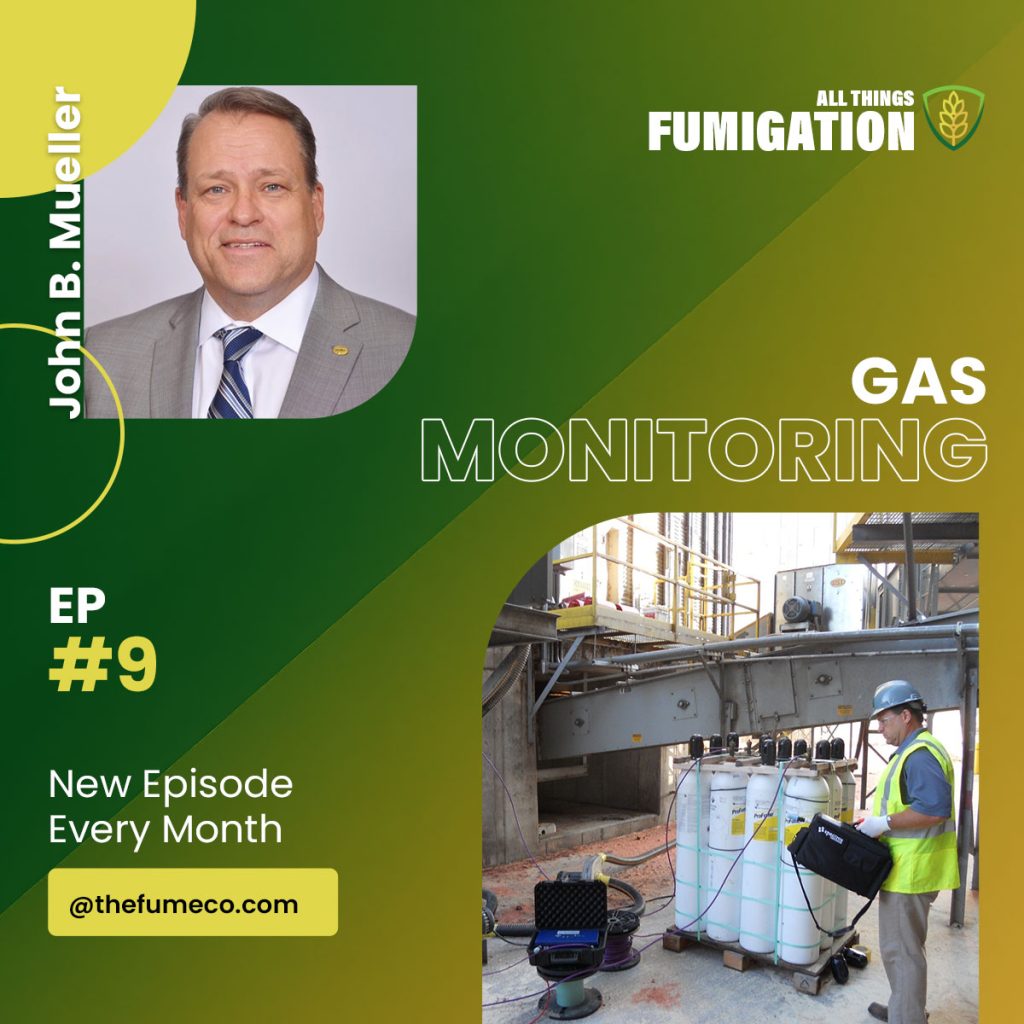
Effective fumigant gas monitoring isn’t just a regulatory checkbox—it’s the backbone of safe, compliant, and successful fumigation operations. In Episode 9 of “All Things Fumigation,” John B. Mueller, veteran fumigator and founder of The Fumigation Company, offers crucial insights for licensed professionals and facility managers alike. This episode dives into how proper gas monitoring impacts safety, compliance, cost control, and, ultimately, fumigation results. Key themes include the science behind gas monitoring, economic impacts, technology upgrades, and actionable best practices to ensure both regulatory and business success.
As a trusted authority with four decades of hands-on experience, John B. Mueller distills the complex world of fumigant monitoring into clear, actionable strategies. Whether you operate a food facility, manage pest control, or run an in-house fumigation team, this episode delivers expert advice to optimize your outcomes.
The Importance of Accurate, Continuous Gas Monitoring
“Would you drive a car without a gas gauge?… The answer is you can’t.”
— John B. Mueller
Why Consistent Monitoring Matters
Continuous, accurate gas monitoring is the linchpin of effective fumigation. The analogy is clear: just as you wouldn’t risk driving without a fuel gauge, you shouldn’t perform fumigation without truly knowing your gas concentrations over time. Spot checks or “dipstick” readings undermine both safety and efficacy.
Failure to monitor can result in sublethal dosing, which allows pests—including resistant strains—to survive and reemerge, wasting both product and money. John B. Mueller emphasizes that many fumigators still rely on manual or random sampling, which risks compliance failures and reputational damage.
Technical Context:
CT (Concentration x Time) products like phosphine, methyl bromide, and sulfuryl fluoride require maintaining minimum gas concentrations to achieve full pest mortality. For example, Dr. Spencer Walsh’s USDA research sets a “hard deck” for phosphine at 500 ppm—dropping below this, even intermittently, compromises efficacy.
Pro-Tip:
Always use continuous, automated gas monitoring—manual spot checks are not defensible and put your treatment’s success and your business at risk.
Gas Monitoring and Economic Efficiency
“Monitoring is where the most potent pest control tool fails or succeeds.”
— John B. Mueller
Cost Implications of Inadequate Monitoring
The shift from methyl bromide to modern fumigants has increased input costs by more than 20x since the 1980s. With application expenses now reaching $2,500 or more per 100,000 cubic feet, failing to protect this investment through accurate monitoring is a direct hit to profitability.
John B. Mueller explains that poor monitoring not only wastes product (improper venting leads to lost gas) but can also lead to expensive re-treatments, customer complaints, lost product grade, and even contract penalties, especially in high-value exports like nuts, grains, and tobacco.
Technical Context:
- Fumigant loss or underdosing can mean $1,000s per event in product waste or crop devaluation.
- Retreatment and demurrage for export failures can cost $2,300–$5,000 per container.
- Upgrading monitoring—from unreliable manual tools to connected, calibrated devices—is a minor investment compared to these risks.
Key Takeaway:
Accurate gas monitoring is not a cost—it’s protection for your profit margin, customer relationships, and business reputation.
Understanding and Selecting the Right Monitoring Technology
“The monitor should give you an accurate number and that number should not be adjustable.”
— John B. Mueller
Technology Comparison & Best Practices
The evolution of gas monitoring tools highlights a critical difference between “good enough” and “defensible” data:
- Colorimetric Tubes (Dräger): Oldest tech; fair for personal safety but highly variable (up to 25% error) for efficacy checks.
- Thermal Conductivity (Fumoscope): Easily manipulated; readings can be “dialed in,” undermining defensibility.
- Electrochemical Sensors: Better for low-range, safety exposure; saturation and accuracy drift at high fumigant concentrations.
- PID Detectors: Useful as a “litmus test” but not for precise dosing control.
- NDIR (Non-Dispersive Infrared): Gold standard for accuracy, repeatability, and integration with connected data platforms.
John B. Mueller warns against using devices that allow manual calibration on the fly, making reports suspicious in the eyes of regulators and customers. As AI and data analysis tools become more prevalent in compliance audits, unreliable data is more easily flagged and challenged.
Pro-Tip:
Invest in accurate, tamper-proof NDIR monitors and connect them to automated data logging—your future credibility and ROI depend on it.
Building Defensible, Consistent, and Efficient Monitoring Processes
“Defensible data is key and understated when we talk about investing in technology.”
— John B. Mueller
SOPs, Partnerships, and Data Consistency
Documented, repeatable processes are essential—not just for compliance, but as a shield against liability and a tool for business growth. Effective teamwork, including coordination with maintenance, security, and QA staff, ensures that monitoring is always prioritized.
Calibration, backup devices, and error code troubleshooting are essential before every job. Predictable, strategically placed monitoring points—especially at historical trouble spots—allow meaningful post-treatment analytics and support transparent reporting to clients.
Practical advice shared in this episode includes:
- “One is none, two is one”: Always have a backup monitor (50:08).
- Start equipment checks and calibration at least one week before scheduled applications.
- Document monitoring locations and readings consistently to enable year-over-year performance reviews.
- Link bioassay samples to monitoring points for in-depth efficacy studies.
Key Takeaway:
Consistent, defensible monitoring and record-keeping transform monitoring from a chore into a strategic business asset—protecting your brand, supporting customer trust, and building new business through industry-leading results.
Gas monitoring isn’t just a technical step—it’s the heartbeat of every successful fumigation. From safeguarding investments and regulatory compliance to building your professional reputation, accurate, continuous, and connected monitoring is non-negotiable. As John B. Mueller stresses, don’t be a dipstick—embrace the science and make technology your competitive advantage.
Listen to the Full Episode:
To explore these topics further, listen to the complete episode on your preferred podcast platform.
Watch on YouTube:
You can also watch the full video episode on our YouTube channel.
[INSERT YOUTUBE LINK HERE]
Subscribe:
Subscribe to All Things Fumigation for expert insights on safety, innovation, and cost-effective strategies. Never miss an episode!
Contact Us:
Need expert fumigation consulting? Schedule a consultation with The Fumigation Company today.