
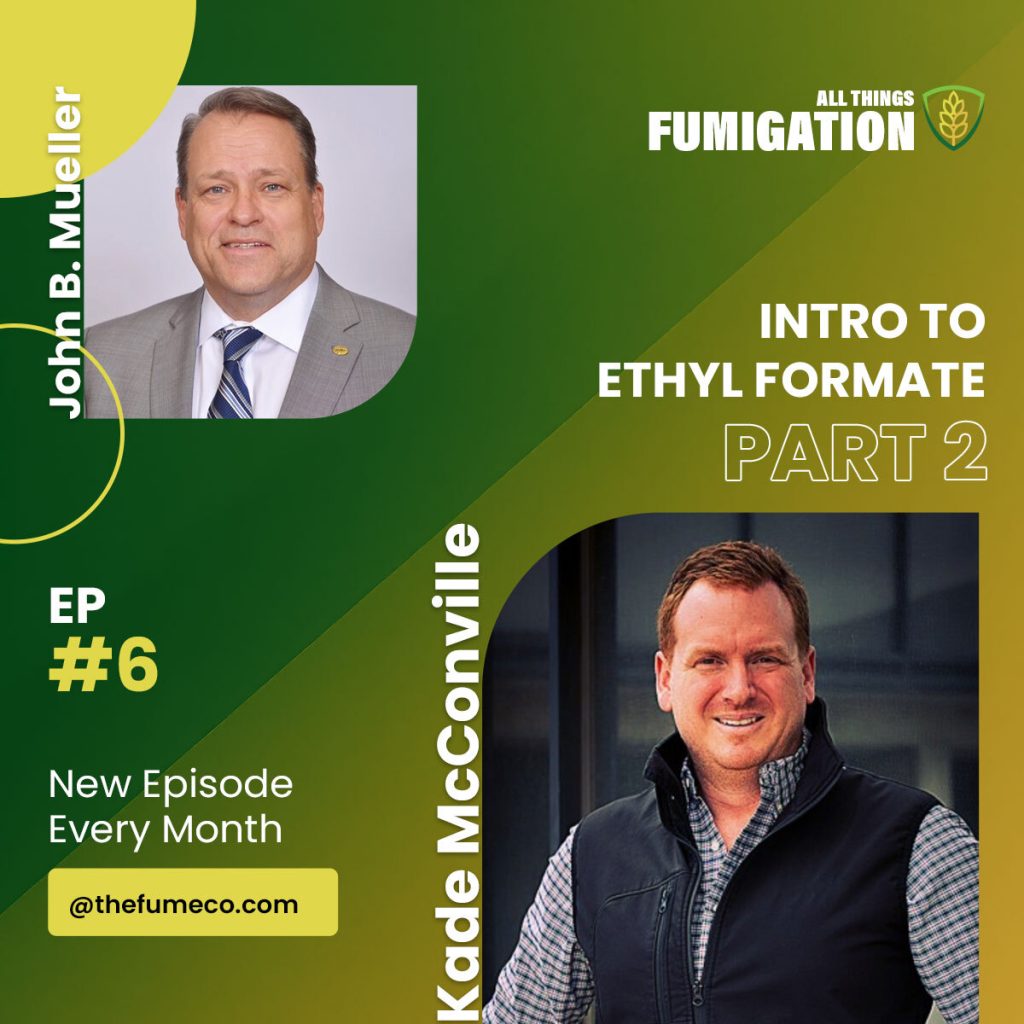
The sixth episode of All Things Fumigation offers a deep dive into the game-changing potential of ethyl formate-based fumigants, with a special focus on eFUME®. Host John B. Mueller, an industry authority and practicing fumigator, sits down with Kade McConville, Executive Director of the Intreso Group and Director at Draslovka Agricultural Solutions. Their detailed discussion uncovers the technical advancements, regulatory milestones, and business implications surrounding eFUME®—a new tool set to transform post-harvest pest management.
This episode is essential listening for licensed fumigators aiming to stay ahead of the regulatory curve and facility managers seeking more effective and compliant pest management solutions. Read on as we break down the episode’s key themes, practical strategies, and what the future holds for organic and conventional fumigation practices.
A Manufacturer’s Perspective: The Evolution of Ethyl Formate Fumigants
As global regulations tighten and the demand for sustainable pest management grows, ethyl formate is stepping up as a significant alternative. Kade McConville highlighted the massive effort required to achieve U.S. registration for eFUME®, a process that spanned seven years and required extensive data collection to meet 21st-century regulatory standards.
“A registration involves a huge amount of data, particularly for products which are 21st-century fumigants… The amount of data, documentation, studies, everything that we need to present to get a registration across the board is astronomical.”
— Kade McConville
Technical Elaboration:
Ethyl formate is a naturally occurring compound, which, when formulated with CO₂, offers effective pest control with a favorable safety profile. The “exempt from residues” status means that there are no concerning residues post-application—a critical consideration for both food safety and organic markets.
Key Takeaway:
Fumigators: When selecting a fumigant for sensitive commodities, opt for those with proven residue exemptions and strong regulatory backing. Facility managers: Prioritize treatments that minimize regulatory risk and maximize market acceptance.
Safety First: Engineering, Application, and Regulatory Compliance
Ensuring the safe and effective deployment of eFUME® is at the core of its design. The product’s formulation, application equipment, and supporting safety protocols are all engineered to mitigate the primary hazards: high-pressure gases, flammability, and the need for specialized delivery systems.
“The equipment that you use for the application of eFUME® is not just plug an eFUME® cylinder into a methyl bromide vaporizer and away you go. This is specialized equipment that we have patented.”
— Kade McConville
Technical Elaboration:
Unlike older chemicals, ethyl formate (especially in the eFUME® mixture with CO₂) is less toxic and less persistent, but does have unique risks. The CO₂ blend addresses the flammability challenge, and operators must use only manufacturer-approved vaporizers.
Regulatory compliance is a central theme:
- GRAS (Generally Regarded As Safe): Ethyl formate’s GRAS status means it is widely accepted as having a high Threshold Limit Value (TLV) of 100 ppm, enhancing both worker and bystander safety.
- Local Registration is Critical: Each country/jurisdiction requires unique registration, even if the chemical is naturally derived.
Pro-Tip:
Always use manufacturer-approved equipment and follow the specific label instructions for ethyl formate-based products. Improper handling can void compliance and create significant safety risks.
Cost, Logistics, and the Business Case for eFUME®
Cost is always a key consideration for both fumigators and facility owners. The episode provides valuable clarity: while the per-unit cost of eFUME® is in line with traditional fumigants, its real-world value emerges in greater operational efficiency and faster commodity turnaround.
“If you look at BMSB right now you need to treat BMSB for 12 hours with sulfuryl fluoride. With eFUME®, it’s 4 hours for exactly the same thing… There are other advantages within the supply chain which will offset some cost as well.”
— Kade McConville
Technical Elaboration:
- Higher Dose Rates: Because ethyl formate is a “softer” (less toxic) fumigant, higher application rates are often needed compared to traditional chemistries.
- Faster Turnaround: The shorter dwell time can significantly improve facility throughput and crew utilization for third-party fumigators—ultimately impacting profitability and service quality.
Key Takeaway:
Decision-Maker Insight: Assess total cost—including labor, downtime, and speed—not just the chemical price. In many scenarios, eFUME® offers lower “total treatment cost” due to faster completion and improved crew efficiency.
The Future: Organic Potential and Industry Collaboration
One of the most exciting developments discussed is the prospect of legitimate organic-compatible fumigation. The lack of persistent residues and the effort to produce non-synthetic ethyl formate could soon open doors for certified organic treatments—an enormous advantage for food brands and export-focused facilities.
“We are working with manufacturers, with some startups, in regards to getting ethyl formate from a… not synthetic source… Now we need to move to that next phase of looking at organic registration.”
— Kade McConville
Technical Elaboration:
Organic certification depends on both the source and formulation of ingredients. While the CO₂ carrier gas in eFUME® is straightforward, achieving organic status for ethyl formate production still requires further regulatory work.
Pro-Tip:
If your business handles or stores organic commodities, engage with your fumigation provider now about pilot programs and future label extensions for organic-compatible treatments. Industry advocacy can accelerate access to new solutions.
Conclusion
This episode of All Things Fumigation underscores the transformative potential of ethyl formate-based fumigants, not only for technical excellence and integrated safety but also as a pathway toward organic and sustainable pest management. For licensed applicators, staying ahead means continuous education and collaboration with product innovators. For facility owners, the emergence of safer, more compliant, and potentially organic options signals a new era for food safety and business continuity.
Call to Action
Listen to the Full Episode
To explore these topics further, listen to the complete episode on your preferred podcast platform.
Watch on YouTube
You can also watch the full video episode on our YouTube channel.
Subscribe
Subscribe to All Things Fumigation for expert insights on safety, innovation, and cost-effective strategies. Never miss an episode!
Contact Us
Need expert fumigation consulting? Schedule a consultation with The Fumigation Company today.
Stay compliant. Stay efficient. Stay informed with The Fumigation Company and All Things Fumigation.